
Why skipping breakfast is costing you your 10am meeting
Your 10am brain fog might have nothing to do with the meeting topic. If you skipped breakfast, you walked in with a depleted prefrontal cortex — and research shows cognitive performance drops precisely in the mid-to-late morning window when the fasted overnight period compounds. This guide explains the mechanism, why high-GI breakfast 'fixes' backfire, and five no-prep desk-ready options that keep blood sugar stable through noon.

🧠 Why skipping breakfast is costing you your 10am meeting
You're sharp. You've got coffee. You're two emails into the morning when the 10am hits — and you already feel the edges softening. Slower recall. That half-second lag before an answer comes. The sentence that ends somewhere it wasn't supposed to.
You might blame the meeting itself, or the topic, or a bad night's sleep. But there's a good chance the real culprit was decided at 7am when you walked out the door without eating anything.
Here's what's actually happening.
⚡ The overnight fast you didn't realize you were extending
When you sleep, your brain doesn't clock out. It consolidates memory, clears metabolic waste, and runs a full maintenance cycle — all of which burns glucose. By the time your alarm goes off, you've already been fasting for 7–9 hours.
Skipping breakfast means walking into your workday while your brain is still running on those depleted reserves. Dr. David S. Ludwig, a nutrition expert at Harvard-affiliated Children's Hospital Boston, puts it plainly: miss your first meal and you start the day with an energy deficit — and you have to tap into reserves to compensate. 1
The problem isn't just "hunger." It's substrate depletion. Your prefrontal cortex — the region responsible for reasoning, working memory, and executive decision-making — is disproportionately sensitive to glucose availability. When blood sugar drops, this area underperforms first.
正在加载图表…
🥑 What the research actually shows about breakfast and cognition
A systematic review of 45 studies from the University of Leeds found that breakfast consumption has a short-term positive effect on attention, executive function, and memory compared to skipping — with effects measurable within four hours of eating. 2
The critical window? Mid-to-late morning — roughly 2–3 hours post-wakeup. That's exactly your 10am slot. Performance in fasted subjects didn't crater immediately after waking; it declined across the morning as the overnight deficit compounded. Breakfast didn't produce a spike of performance above baseline — it prevented the drop.
A 2024 Mendelian randomization study published in BMC Psychiatry took this further, finding a statistically significant causal association between breakfast skipping and lower cognitive performance scores (β = -0.16, 95% CI: -0.29 to -0.04), independent of other lifestyle factors. 3
What this means in practice: the person who eats breakfast doesn't necessarily feel smarter. They just don't degrade.
🍳 What you eat matters more than you think
Not all breakfasts are equal. The Leeds review found that lower glycemic index (GI) breakfasts — those that produce a slower, steadier rise in blood glucose — showed more consistent cognitive benefits than high-GI options. 2
This is the hidden trap of the "convenient" breakfast: a plain bagel, a sweetened yogurt parfait, a sugary granola bar, or a muffin from the conference room all spike blood sugar fast. The rapid rise triggers an insulin response, blood sugar drops, and by 10:30 you've engineered the exact crash you were trying to avoid.
Harvard Medical School's guidance echoes the research: combine slowly-digested carbohydrates + protein + fat to keep blood glucose stable across the morning. 1

🧠 The desk-ready breakfast formula (no meal prep required)
The goal is a breakfast that clears the glycemic hurdle without requiring 30 minutes in the kitchen. Each of these takes under 5 minutes and travels well:
| Breakfast option | Why it works |
|---|---|
| 2 hard-boiled eggs + whole-grain toast | Protein + slow carbs; no blood sugar spike |
| Greek yogurt (plain) + handful of walnuts | Protein + healthy fats; slow GI, zero prep |
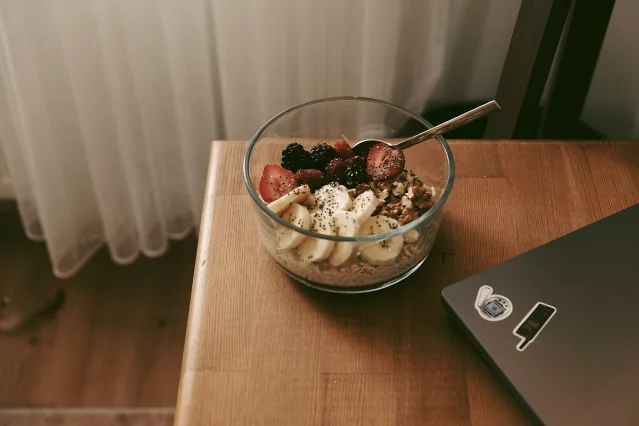
| Overnight oats + almond butter | Fiber + protein + fat; make the night before |
| Cottage cheese + apple slices | Casein protein + fiber; fills the gap to lunch |
| Avocado toast on whole-grain bread | Fat + fiber; lower GI than white-bread options |
The pattern: protein to slow digestion, fat to blunt the insulin spike, fiber to steady the glucose curve. If your breakfast hits all three, you're designing a stable cognitive baseline through noon.
What to avoid: skipping these macros entirely and grabbing just a banana, just a juice, just a piece of toast. Carbs alone — even good ones — without protein or fat accelerate the glucose ride and the inevitable drop.
⏰ The 3-window morning eating structure
If you're using the five-window framework from earlier this week, here's how breakfast fits precisely:
- Window 1 — 7 to 9am (Anchor Breakfast): This is the non-negotiable. The longer you delay it into Window 2, the deeper the deficit you're digging. Eating within 60–90 minutes of waking catches blood glucose before it bottoms out.
- Window 2 — 10 to 11am (Bridge Snack): This prevents the late-morning drop even when breakfast was strong. A protein-forward snack here is your insurance against the 10am fade.
- Window 3 — 12:30 to 1:30pm (Functional Lunch): If Window 1 and 2 are handled, lunch becomes maintenance rather than rescue.
Skipping Window 1 means Window 2 is playing catch-up. And by the time you've caught up, the 10am meeting is over.
🔧 The two structural micro-habits
Neither of these requires meal prep. Both remove the main friction.
1. Put it in the bag the night before.
Overnight oats, hard-boiled eggs, or a container of Greek yogurt with nuts — if it's already packed when you wake up, the decision is made. You're not solving a problem at 7am; you're executing a plan from the night before.
2. Reframe the time cost.
A bowl of oats takes 3 minutes. Greek yogurt with walnuts takes 90 seconds. The cognitive cost of the meeting you underperform in is not recoverable. The investment is lopsided in one direction.
What's your go-to?
You've already built in caffeine windows and snack drawers. Now I'm curious: what does your actual breakfast look like on a typical work morning? Are you eating within the first hour of waking, or is "breakfast" usually a coffee and a granola bar at 9:45?
Drop it in the comments — and let me know if the 10am fog is something you've felt before.
围绕这条内容继续补充观点或上下文。