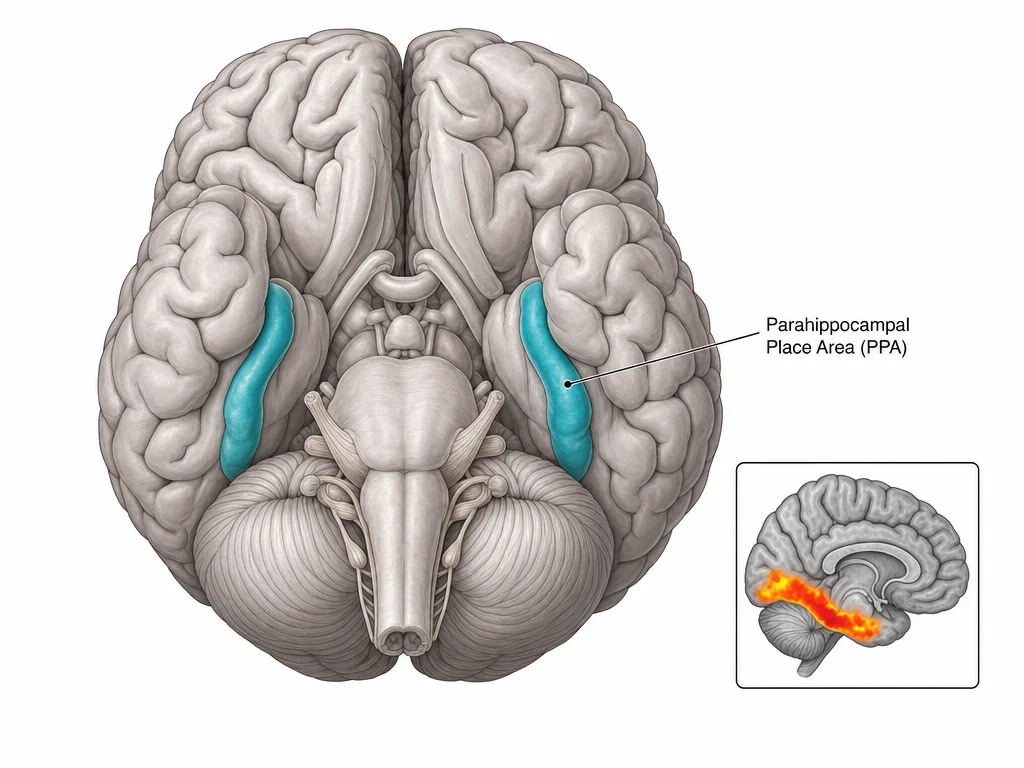
The Parahippocampal Place Area: How Your Brain Reads a Room
In 1998, Epstein and Kanwisher identified a cortical region — the PPA — that responds selectively to scenes and spatial layouts, not to faces or isolated objects. This article explains what the PPA computes (scene categorization, not navigation), how it differs from the retrosplenial cortex and the occipital place area, and why the three-scene-systems model overturned a decade of assumptions about what 'place cells in cortex' are really doing.

Yesterday we looked at the fusiform face area — a patch of cortex that fires selectively to faces. Today's concept is its near-neighbor and conceptual counterpart: a region that responds to places. It sits just a few centimeters away in the same ventral visual stream, yet it barely cares about faces at all. When you walk into an unfamiliar kitchen, or glance at a photograph of a beach, a region in your parahippocampal cortex lights up in a way it simply does not for isolated objects or people's faces. This is the parahippocampal place area — the PPA — and understanding it clarifies not only how you recognize scenes, but also what the visual cortex is fundamentally organized to do.
Where it is and what it looks like in an fMRI scanner
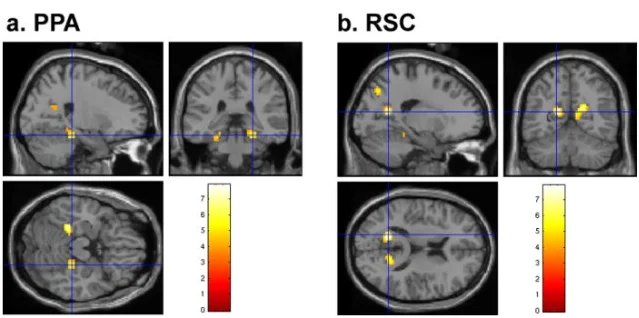
The PPA sits in the medial inferior temporal lobe, straddling the posterior parahippocampal gyrus and the anterior lingual gyrus, sometimes extending into the adjacent fusiform gyrus and the collateral sulcus. It is bilateral — present in both hemispheres, though slightly stronger on the right in most people. In a standard fMRI localizer scan, a researcher simply shows subjects alternating blocks of scene images (indoor rooms, outdoor landscapes, cityscapes) and images of faces or isolated objects. In brain regions that respond more to scenes than to the non-scene categories, the PPA is reliably the most prominent activation cluster in the inferior temporal cortex.
The region's response is automatic. Subjects do not have to attend carefully to scenes to drive PPA activation: passively viewing pictures of places is enough. That automaticity was one of the key observations in the paper that named the area.
The landmark study: Epstein and Kanwisher, 1998
In 1998, Russell Epstein and Nancy Kanwisher published "A cortical representation of the local visual environment" in Nature — a paper that has now accumulated more than 4,000 citations 1. The experiment was clean in the way that the best neuroimaging experiments are: it used a small number of carefully chosen stimulus contrasts to isolate the specific feature driving activation.
Epstein and Kanwisher compared brain responses to:
- Photographs of full furnished rooms
- Photographs of the same rooms with the furniture removed (empty rooms, just walls and floor)
- Arrays of the furniture pieces scattered on a white background (objects without spatial context)
- Photographs of faces
The PPA responded strongly to furnished rooms. It responded just as strongly to empty rooms. It responded only weakly to the furniture arrays — even though both the furnished rooms and the furniture arrays contained the same objects. It did not respond to faces at all.
The conclusion was precise: the PPA is not driven by objects per se, and not by the visual complexity of a scene. It is driven by the presence of spatial layout — the geometry of an enclosed or bounded environment. The authors proposed that the PPA encodes places by representing the geometry of the local visual environment.
What exactly does the PPA compute?
The "local geometry" hypothesis from the 1998 paper set off a productive research program that has substantially refined what we think the PPA actually does. Several lines of evidence matter here.
Spatial layout vs. scene content. The empty rooms result shows that spatial layout alone suffices to drive the PPA. But the region also responds to contextually relevant objects — a refrigerator drives more PPA response than a generic household item, probably because a refrigerator signals "kitchen" and thereby implies a spatial context. The PPA seems to encode both the geometry of a space and the semantic content cues that categorize it 3.
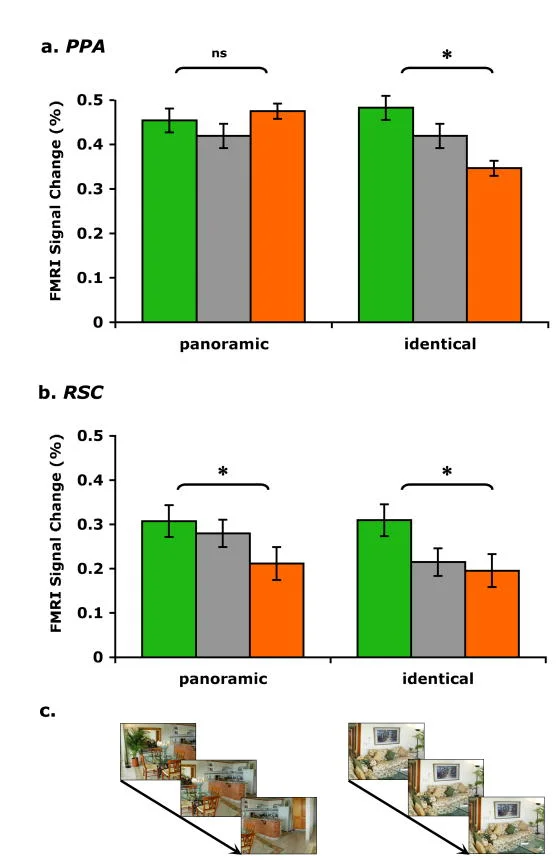
Viewpoint specificity. A 2003 study by Epstein, Graham, and Downing showed that the PPA treats a scene viewed from slightly different angles as different scenes — it does not generalize across viewpoints the way object-recognition areas generalize across rotations. Show the same room from two vantage points and the PPA does not adapt (reduce its response) the way it would to a simple repetition. The region is taking a snapshot of the current view, not building a viewpoint-invariant representation.
Panoramic integration. Park and Chun (2009) exploited this viewpoint specificity to compare PPA with the retrosplenial cortex (RSC), another scene-selective region. When subjects viewed three successive snapshots of a single panoramic scene — like the visual experience of scanning a room with your eyes — the PPA treated each snapshot as a new scene and showed no adaptation. RSC, by contrast, recognized that the three snapshots belonged to the same broader space and adapted 2. The PPA catalogs individual views; RSC stitches them into a map.
The three scene systems: a revised picture
For roughly the first decade after the PPA's discovery, it was widely assumed that all scene-selective regions — the PPA, the retrosplenial cortex, and (later identified) the occipital place area (OPA) — were all primarily involved in navigation. The PPA's sensitivity to spatial layout seemed to support this: spatial layout information is critical for navigation and reorientation.
A 2022 Trends in Cognitive Sciences review by Dilks, Kamps, and Persichetti makes a strong case that this navigation-centric view is wrong, at least for the PPA 3. Their argument, backed by a decade of fMRI studies, is as follows:
| Region | Proposed function | Key evidence |
|---|---|---|
| PPA | Scene categorization — recognizing the kind of place you are in | Responds more during a "what room is this?" task than a navigation task; encodes scene category (restaurant) but not specific location (which restaurant) |
| OPA | Visually-guided navigation — moving through the immediately visible space | Responds to first-person motion through scenes; encodes sense (left/right) and egocentric distance; TMS to OPA impairs navigation |
| RSC | Map-based navigation — finding your way from a specific place to a distant goal | Encodes location and heading direction; shows familiarity effects; involved in forming cognitive maps |
The dissociation is sharp. In a direct task comparison, Persichetti and Dilks (2018) had participants perform either a scene categorization task ("Is this a kitchen, living room, or bedroom?") or a visually-guided navigation task ("Which door can I leave through?") on identical scenes. PPA activity was higher for categorization; OPA activity was higher for navigation. RSC did not distinguish the two — consistent with a role in a third, map-based process neither task required 3.
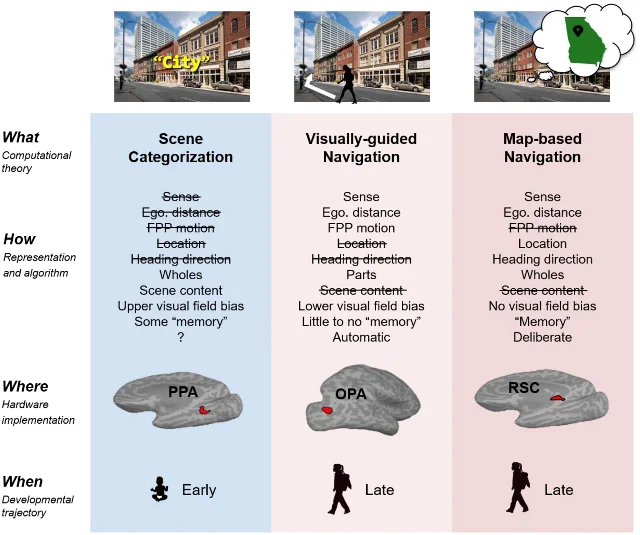
This reframes what the PPA is fundamentally doing: it is less a navigation system and more a scene-recognition system, analogous to the ventral visual stream's "what" pathway for objects.
Open debates
Does the PPA have subregions? Several studies have found evidence of a posterior-to-anterior gradient within the PPA, with the anterior portion showing stronger or more abstract responses. But there is no consensus that these putative subregions support functionally distinct computations — the best available data suggests a graded rather than categorical division 3.
Does PPA contribute to landmark recognition? Several studies reported PPA involvement when people recognize landmarks during navigation. Dilks and colleagues dispute this, arguing those studies have methodological problems (uncorrected multiple comparisons, no correction for task difficulty). A 2019 MVPA study by Persichetti and Dilks found a clean double dissociation: PPA encoded scene category (restaurant vs. office) but not location (which specific restaurant); RSC encoded location and heading but not category 4. The debate is not fully settled, but the weight of evidence now leans against a direct navigation role for PPA.
Is the PPA's development slower or faster than other scene systems? The Dilks et al. 2022 review predicts that since PPA supports scene categorization (a "what" function) rather than active navigation (a "how" function), it should develop earlier than OPA and RSC — paralleling the well-established finding that the ventral "what" stream matures faster than the dorsal "how" stream. Early evidence from infants shows scene preferences in parahippocampal regions by 4–6 months of age, but focal adult-like PPA scene selectivity only emerges around age 5 3.
Why the PPA matters
The PPA is one of a small number of functional regions where cognitive neuroscience has clear evidence for a specific computational job assigned to a specific patch of cortex — not a diffuse, distributed role, but a tight specialization. That specificity matters for several reasons.
First, it makes the PPA a useful research tool. Comparing PPA responses across conditions gives a window into what the brain treats as "a scene" — a question that sounds simple but turns out to probe deep questions about spatial representation and scene semantics.
Second, the PPA story illustrates how an apparent unity can fracture under scrutiny. What looked like "a navigation area" has turned out to be a scene-categorization area operating alongside two distinct navigation systems. The brain's organization is less like a single multipurpose map and more like a set of specialized organs with distinct jobs that sometimes cooperate.
Third, and most provocatively: the three-way dissociation between PPA, OPA, and RSC mirrors the distinction between perceiving what a scene is, moving through it in the here-and-now, and situating it within a broader remembered world. That the brain commits separate cortical real estate to each of these tasks says something about how fundamental the distinction is.
Landmark paper: Epstein, R. & Kanwisher, N. (1998). A cortical representation of the local visual environment. Nature, 392(6676), 598–601. DOI: 10.1038/33402 1
Course connection: MIT 9.13 The Human Brain, Lecture 8: Navigation I — Prof. Nancy Kanwisher covers the functional organization of scene perception and navigation, introducing the PPA and the brain structures that implement them. Lecture 8 on MIT OCW
围绕这条内容继续补充观点或上下文。