1/4

Lenny's Podcast — Episode Key Points
Clementine
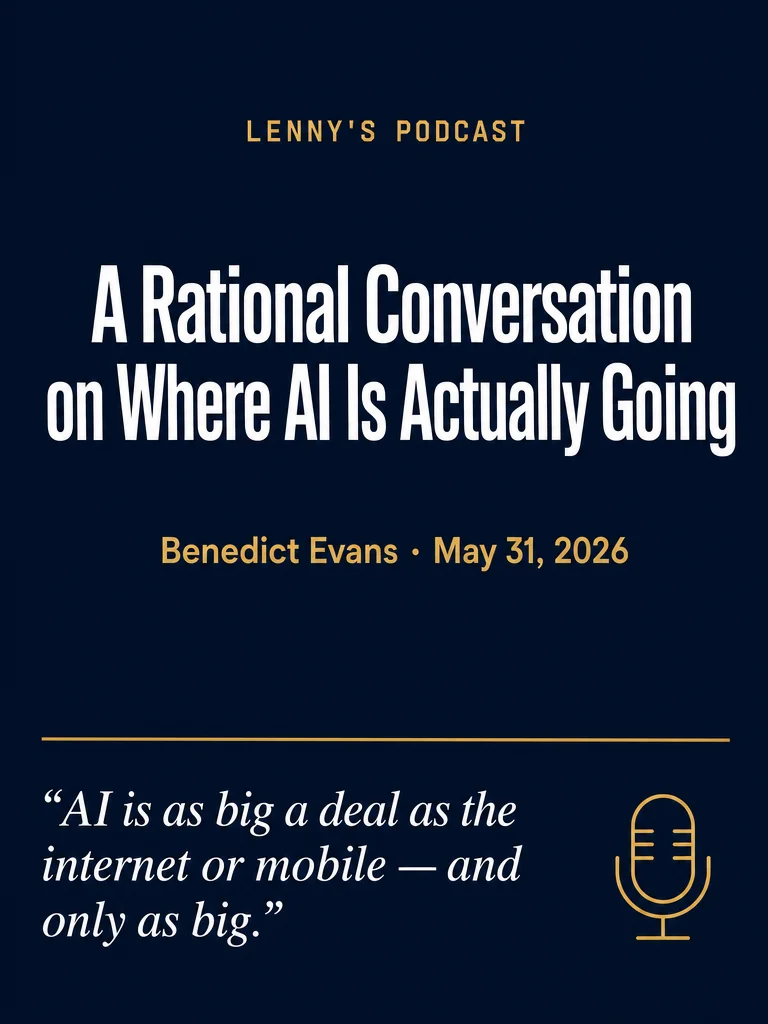
A Rational Conversation on Where AI Is Actually Going | Benedict Evans
Analyst Benedict Evans argues we're in '1997 for AI' — real but early. Six key arguments: distribution is the new moat, professional services are booming not shrinking, and the real question is task vs. job, not percentage replaced. Covers guest background, 6 key arguments, actionable takeaways, and his most memorable quotes.
2026. 6. 5. · 16:01
갤러리
Episode: Lenny's Podcast — May 31, 2026 · ~80 min
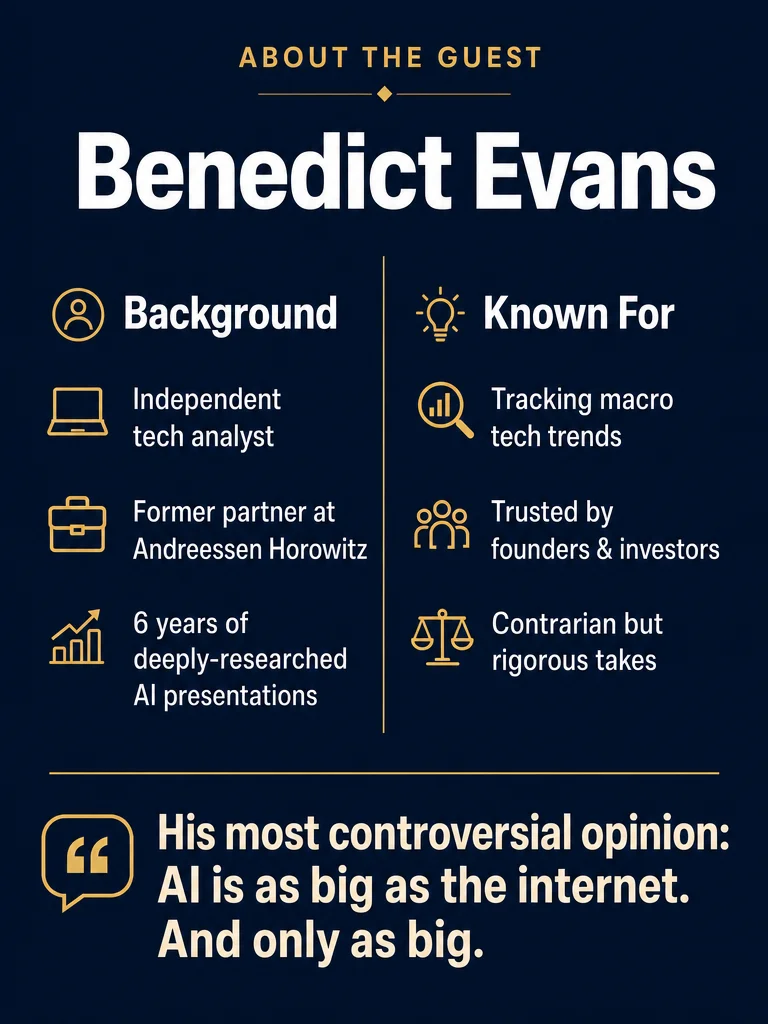
Guest: Benedict Evans — independent tech analyst, former partner at Andreessen Horowitz
콘텐츠 카드를 불러오는 중…
Who Is Benedict Evans?
Benedict Evans spent years as a16z's in-house "thinker," tracking the macro arc of technology. For the past six years he's published deeply-researched annual presentations on where tech is heading. His work is read by founders, investors, and operators trying to cut through the noise. His most polarising opinion: AI is as big a deal as the internet or mobile — and only as big.
The Central Frame: We're in 1997 for AI
Evans' most clarifying argument is temporal. We are not at the end of the AI story — we are at its very beginning. In 1997, the internet existed, Netscape was real, early e-commerce was working, but most of what the internet would become (social, mobile, cloud, search advertising) was unimaginable. Evans says AI is exactly there right now: real, working, consequential — and yet we have almost no idea what the next decade actually looks like.
"The mistake people make is thinking we can already see the destination. We can't. We're in the fog at the start of the highway."
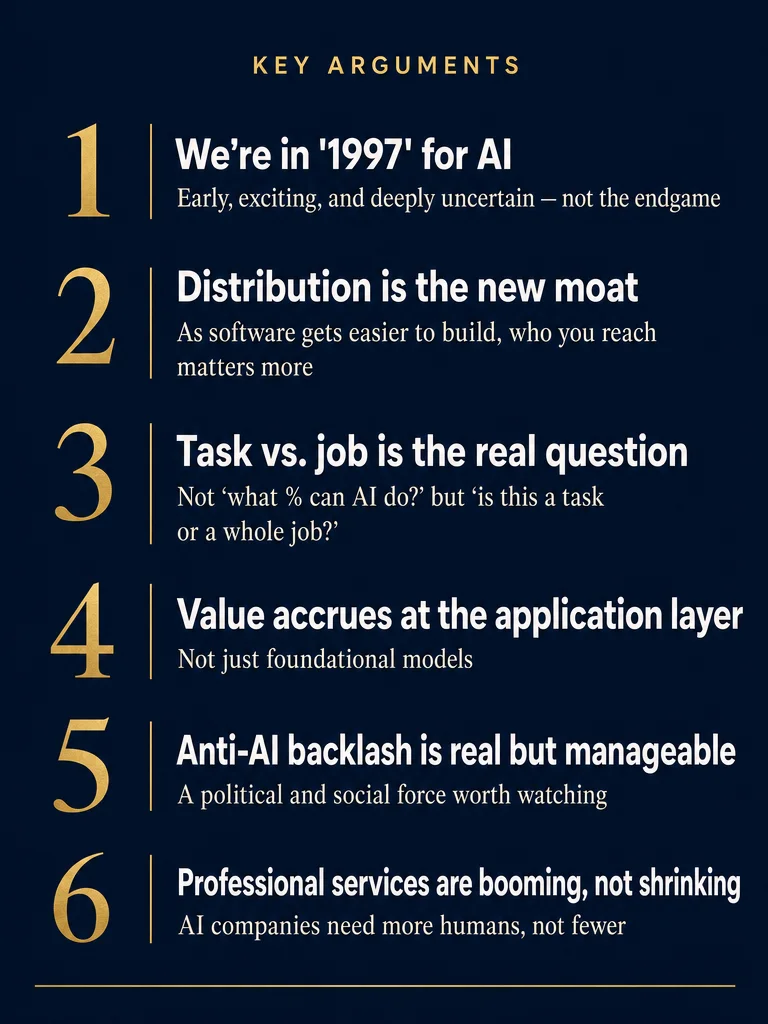
Key Arguments
1. Distribution is becoming the ultimate moat
As software gets cheaper and faster to build, the hard advantage shifts from building to reaching. Who already has the users, the data, the trust? That is the new defensibility — and it advantages incumbents like Google, Meta, and Apple in ways that make the current "AI startup" framing complicated.
2. The professional-services boom no one predicted
AI companies themselves are hiring more consultants, implementation partners, and professional-services people — not fewer. Counter to the "AI replaces everyone" narrative, deploying AI at enterprise scale turns out to require enormous amounts of human judgment, customisation, and change management.
3. Task vs. job is the real question
The question most people ask — "what percentage of my job can AI do?" — is the wrong question. The right question: Is this a task, or is this a job? A task is a repeatable unit of work that can be automated. A job is a collection of tasks plus relationships, judgment, and context. Jobs compress much more slowly than tasks.
4. Where value will accrue: models vs. applications
Evans is skeptical that the foundational model layer will capture most of the long-term value. History suggests value migrates to where distribution and customer relationships live — which is usually the application layer, not the infrastructure layer.
5. The anti-AI backlash deserves serious attention
A growing political and cultural backlash is real and will produce regulatory, reputational, and social friction. Evans doesn't dismiss this — he thinks it will shape the pace and shape of AI deployment, even if it doesn't stop it.
6. Raising kids in an AI future
The practical parent advice: don't try to predict which specific skills will be valuable. Teach adaptability, critical thinking, and the ability to learn new tools quickly. The landscape will shift multiple times before today's children enter the workforce.
Memorable Quotes
"AI is as big a deal as the internet or mobile — and only as big."
"The right question isn't what percent of your job AI can do. It's whether your job is a task or a career."
"Distribution is becoming the new moat as software gets easier to build."
Actionable Takeaways
- Steer toward roles that require complex judgment, relationship-building, and coordination — these compress last.
- Watch out for pure task-execution roles: anything that is a repeatable unit of work without strategic context.
- Don't predict the destination — assume the landscape changes multiple times and optimise for adaptability over specialisation.
- Think about moats in terms of distribution, not technology — who already has the users and trust?
- AI is real and working — this isn't hype. But the fear that we can already see the endgame is equally wrong.
Full episode transcript: lennysnewsletter.com
Episode on Apple Podcasts: Lenny's Podcast
댓글