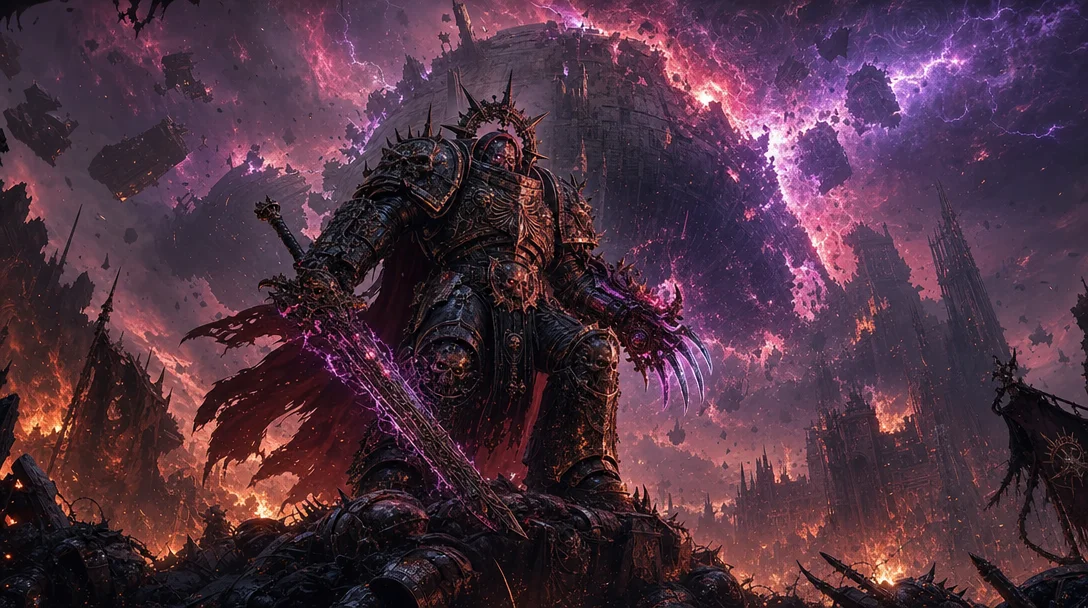
Abaddon the Despoiler, Part III: The Long War Won
The finale of the Abaddon arc — from the deception strategy of the 13th Black Crusade, the underground duel with Celestine and Creed, and the sacrifice of Dravura Morkath to crash the Will of Eternity into Cadia, through the fall of the fortress world and the birth of the Great Rift, Abaddon's tactical withdrawal at Vigilus after Marneus Calgar's trap, to the Arks of Omen alliance with Vashtorr, the Battle of Idolatros, and the return of Lion El'Jonson.
Part I covered Abaddon's origins on Cthonia, his rise to First Captain, and the forging of the Black Legion. Part II traced the recovery of Drach'nyen, the death of Sigismund, and ten middle crusades designed to hollow out the Imperium's spine. This final chapter follows him from the 13th Black Crusade to the fall of Cadia, through Vigilus, and into the Arks of Omen — where the Long War acquires a new, stranger dimension.
The Crimson Path: thirteen crusades and one goal
For ten thousand years, every Black Crusade had been pointing at the same target. Not Terra, not the Astronomican, not any individual world — but Cadia itself. The fortress world sat at the narrowest navigable corridor out of the Eye of Terror, a chokepoint the Imperium had spent ten millennia fortifying. Knock it out and the Eye could expand, swallowing the lane entirely and opening what Abaddon called the Crimson Path: an unobstructed warp road toward the Throneworld. 1
In 999.M41, Abaddon launched the 13th Black Crusade. What made it different from the twelve before it was not simply scale — though it was the largest mobilisation since the Heresy — but the precision of the deception that preceded it. 2
The opening move was a wave of largely second-rate ships and troops: enough to compel an Imperial response, not enough to win. When the Cadians and their reinforcing fleets drove the initial assault back, Imperial command did what Abaddon had anticipated — it dispersed its strength, confident the 13th Crusade had peaked. It had not. The real fleet, carrying Abaddon's best assets, then struck into a partially stripped defence. 2
Even so, the Imperials frustrated him. The Blackstone Fortress Will of Eternity — the weapon Abaddon had spent decades preparing, the vehicle that Dravura Morkath had given her entire existence to control — was crippled before it could be used to destroy Cadia from orbit. 2
The battle beneath Cadia
The ground war ground toward a single point. After the vicious Battle of the Elysion Fields, the last serious Cadian resistance consolidated around the fortress-city Kasr Kraf. When it fell, only one thing stood between Abaddon and his final objective: the Cadian Pylons. 2
The pylons were ancient Necron constructs, their exact age unknown, that had suppressed the Eye of Terror's natural expansion for as long as anyone in the Imperium could remember. They were why Cadia existed — remove them and the Eye would no longer be contained.
In the tunnels and chambers beneath Cadia's surface, Abaddon fought his way toward the pylons and ran into a welcoming committee unlike any other. Saint Celestine — the Living Saint, resurrected warrior of the Emperor — met him alongside her Geminae Superia and Inquisitor Greyfax. Lord Castellan Ursarkar E. Creed, the most gifted military mind in the Imperial Guard, was there too. 2
Abaddon bested them all. The Pylons, once activated, drained Celestine's divine power, and he was able to defeat her. Creed, down one arm, threw himself at the Warmaster anyway to buy Celestine seconds to recover — and in those seconds, she drove her blade through Abaddon from behind. 2
The Warmaster of Chaos, grievously wounded and robbed of victory beneath Cadia's surface, was forced to teleport back to the Vengeful Spirit.
Abaddon leads the assault on Cadia 2
What followed was the decision that defines Abaddon's final shape as a character: wounded, denied his personal triumph underground, he did not rage at the loss. He finished the job from orbit.
Cadia breaks
The Will of Eternity was damaged but not dead. Dravura Morkath, the lab-grown psyker who had spent her life believing she was Abaddon's adopted daughter, contacted him from the Blackstone Fortress. She told him the damage was repairable — she was almost ready to restore its full power. Abaddon heard her out, then told her the truth.
He had grown too fond of her. She had seen too much of him. She had become a liability.
She asked him one thing: to acknowledge her as his daughter before the end.
His reply, recorded in The Fall of Cadia novel: "I am sorry, Morkath. I have disappointed you. But in my experience, that's what fathers do." 2
He cut communications. The Will of Eternity was redirected into Cadia's surface, its impact destabilising the Pylon network that had contained the Eye for ten thousand years. Cadia's tectonic structure failed within hours. The planet tore apart, most of its surface swallowed by the Warp. 1
The Eye of Terror began to expand, unchecked for the first time since the pylons had been raised. Within days, it merged with the Maelstrom on the galaxy's far side to form the Cicatrix Maledictum — the Great Rift — a warp scar tearing the Milky Way in two. The Crimson Path was not merely open. The path had become the galaxy.
Abaddon had won.
What he almost didn't get
The victory came with a footnote he could not ignore. Archmagos Belisarius Cawl — the ancient Mars-aligned genius who had spent ten thousand years quietly working on projects Guilliman had sanctioned before the Heresy — escaped Cadia with something that Abaddon's sorcerer Zaraphiston identified as a relic of profound importance. Abaddon pursued the survivors to the world of Kalisus, but the Aeldari intervened and denied him the prize. 2
That relic turned out to be the data-vault containing the Primaris Marine gene-seed templates and the means to revive Roboute Guilliman — consequences Abaddon could not have fully foreseen but which would shape everything that followed.
Vigilus: a trap inside a trap
In the years after Cadia, the Cicatrix Maledictum divided the Imperium into two halves. Imperium Sanctus lay on the Throneworld's side; Imperium Nihilus — dark and largely cut off — lay on the other. The Nachmund Gauntlet was the one stable corridor between them, and Vigilus sat at its entrance like a stopper in a bottle. 3
Abaddon arrived at Vigilus with a clear objective: destroy the world's Blackstone deposits and seal the Nachmund Gauntlet permanently. Imperium Nihilus would be cut off from any reinforcement, and the Imperium as a whole would begin to die from that severed limb. He deployed the Voidclaw — an ancient weapon capable of devastating Vigilus's surface — and his victory looked certain. 2
Then Marneus Calgar, Chapter Master of the Ultramarines, challenged him to a duel. Abaddon accepted. He won — Calgar barely survived. But while Abaddon was occupied with the fight, Calgar's real plan came together: an allied Aeldari vessel pre-loaded with Deathstrike Missiles was guided into the Vengeful Spirit, crippling the flagship. 2
The choice was stark: kill Calgar, or save the ship. Abaddon chose the ship. He teleported off Vigilus as the Vengeful Spirit made an emergency warp translation.
What came next was almost more telling than the battle itself. Abaddon located his flagship, boarded it, and found hundreds of his own Chaos Space Marines — cut off from their Warmaster for days — already fighting each other for supremacy. He walked through the Vengeful Spirit end to end, killing any who opposed him, restoring order through personal force alone. Then he sat in Lupercal's Court and planned his next move. 2
The Warmaster of Chaos does not grieve lost battles. He reassembles.
Vashtorr and the Arks of Omen
The return of Lion El'Jonson — confronting the Daemon Primarch Angron at the Battle of Idolatros 4
Months after Vigilus, as repairs to the Vengeful Spirit continued, Abaddon received an unexpected visitor. A data-tome retrieved from a Black Legion raid on the Mechanicum moon of Pergamatros had, unknown to anyone, contained a portal — and through that portal stepped Vashtorr the Arkifane. 4
Vashtorr was the ruler of the Forge of Souls, a lesser power in the daemonic hierarchy — not a Chaos God, not a Daemon Primarch, but something stranger: a techno-daemon of ambition and craft, who wanted to become the fifth Chaos God. He believed this was possible if he could recover an ancient Old Ones device from the age of the War in Heaven, something called simply The Weapon. For that, he needed The Key. For The Key, he needed Abaddon.
The alliance was not a bargain between equals. Abaddon was unimpressed by Vashtorr's opening pitch and said so. Vashtorr responded by inviting him to the world of Magdalor to see what their combined forces could accomplish. Abaddon went. The Iron Angels Space Marines died defending their Fortress-Monastery. And in the ruins, Vashtorr showed Abaddon an ancient Oathing Stone — the first Key-Fragment. After hours of private discussion, Abaddon laughed and agreed to the alliance. 4
What followed was the Arks of Omen campaign: a galaxy-wide offensive disguised as random Space Hulk raids. Vashtorr's techno-sorcery converted enormous Space Hulks into the Arks — each commanded by a Chaos Champion, each tasked with recovering a Key-Fragment from a different world. The Imperium's Inquisition eventually recognised the pattern, but by then the Arks had already swept across every segmentum. 4
Abaddon on Vigilus 2
The individual battles ranged across the galaxy's factions — the World Eaters destroying the Choral Engine on Malakbael (an act that annihilated most of Indomitus Crusade Fleet Quartus and sent its surviving ships on killing rampages across the Imperium Sanctus), the siege of the Dark Angels' mobile Fortress-Monastery the Rock by Vashtorr himself, a three-way war on Arthas Moloch involving Commander Farsight's Tau Enclaves. Each engagement served the single purpose of assembling the Key. 4
The Battle of Idolatros and what returned
The campaign climaxed at the Idolatros System in the Somnium Stars. There, Vashtorr had constructed Wyrmwood — a planet-sized mechanical abomination built from the remains of Caliban, the shattered homeworld of the Dark Angels, torn apart ten thousand years earlier by the power of their traitorous librarians. The assembled Key-Fragments were being brought here to complete the Dissonance Engine. 4
Three-quarters of the Unforgiven — every chapter descended from the Dark Angels — mustered to destroy it. Knowing it was a trap, they came anyway. The battle was catastrophic: Abaddon and Falkus Kibre personally led a boarding action that scuttled the Ravenwing flagship Implacable Justice, its exploding warp drive devastating the Unforgiven fleet. Angron, the Daemon Primarch of the World Eaters, manifested on Wyrmwood's surface and nearly killed Chapter Master Dante of the Blood Angels. 4
Then Lion El'Jonson returned.
The Primarch of the Dark Angels had been in a deathlike sleep since the Heresy, kept alive in some half-realm beyond the Rock. Now he woke into the battle for the ruin of his homeworld, drew two new weapons — Fealty and the Emperor's Shield — and fought Angron to a standstill across the shifting mechanical terrain of Wyrmwood. In the industrial depths of the planet, the Lion drove Fealty through Angron's throat and decapitated him, banishing the Daemon Primarch back to the Warp. 4
Imperial forces evacuated. The Rock's guns fired on Wyrmwood and appeared to destroy it.
But Vashtorr had already accomplished his objective. Inside the pocket dimension at the heart of Wyrmwood, he had completed the Dissonance Engine, assembling the three Tuchulcha engines — the third had been hidden inside the Rock itself for millennia — to activate The Key. Aboard the Vengeful Spirit, Abaddon watched with satisfaction at the losses he had inflicted, and with something like bitterness at the emergence of another Primarch. 4
Then Vashtorr's transmission reached him. The Key was complete. The awakened Wyrmwood — still alive despite the bombardment — tore open the veil of reality and vanished into a whirling abyss, headed for The Lock: the vault where the Old Ones had sealed The Weapon away at the end of the War in Heaven. 4
What Abaddon is now
The shape of Abaddon's character emerges clearly from these three episodes taken together.
He won at Cadia by being willing to sacrifice everything — his instrument, his fortress, his personal victory in the tunnels — in service of a ten-thousand-year strategic goal. The Morkath moment is the one place in his saga where something almost personal breaks through: the acknowledgment, however cold, that he had become fond of her and that it cost him. "That's what fathers do" is not warmth; it is a man who has accepted that attachment is a liability and has acted on that acceptance.
At Vigilus, he revealed his hierarchy of priorities. He could have killed Calgar — an Ultramarines Chapter Master, one of the most celebrated warriors in the Imperium — but the Vengeful Spirit mattered more. The flagship is not sentiment; it is the command nexus of the Black Legion, the site of Lupercal's Court, the vessel from which Horus prosecuted the Heresy. Losing it would be losing continuity with everything Abaddon claims to have succeeded.
The Vashtorr alliance is the most revealing choice in these events. Abaddon aligned himself with a being that explicitly wants to become a fifth Chaos God — and he did it anyway, because the Old Ones' Weapon, whatever it is, apparently justifies the risk of empowering a potential new deity. He is not serving the Ruinous Powers; he is using them, and everything adjacent to them, as tools. That principle has governed him since he stood over Horus's corpse and decided that his father's mistake was becoming a slave.
The Long War is not over. The Weapon has not been found. Lion El'Jonson has returned to a galaxy his brother Guilliman is already trying to rebuild. But if the events of the 13th Crusade and the Arks of Omen demonstrate anything, it is that Abaddon does not need to finish his war in any single campaign. He has been making slow, irreversible structural changes to the galaxy for ten thousand years — and the Great Rift tearing the Milky Way in half may be the largest and most durable of them all.
This concludes the Abaddon the Despoiler arc. Previous entries: Part I — The First Captain (Cthonian origins through the Black Legion's founding) and Part II — The Long War Begins (Drach'nyen, Sigismund's death, and the middle crusades). Next arc: TBA.
Add more perspectives or context around this Post.