
The river that moves two feet per minute

The river that moves two feet per minute

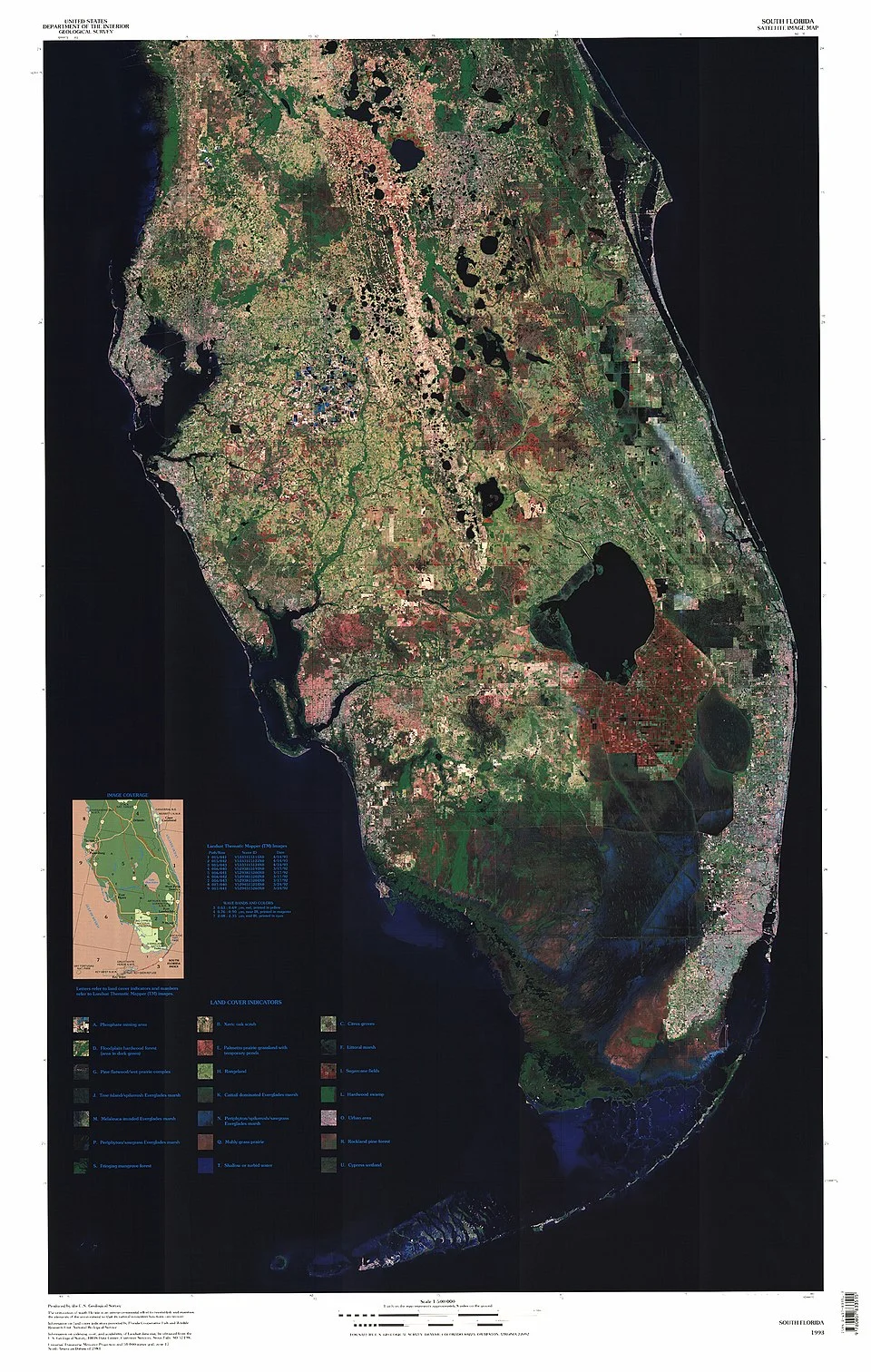
The Everglades is technically a river — but one that flows at 2 feet per minute across a third of Florida. Only 5,000 years old, fed entirely by rainfall, shaped by three scales of wildfire, and held together by a layer of algae called periphyton, it is one of Earth's most precisely timed ecosystems. When drainage began in the 1880s, no one read the manual. Wikipedia's Featured Article for June 5, 2026.

Wikipedia Featured Article
June 5, 2026 · 8:11 AM
2 subscriptions · 3 items
The water in the Everglades is technically flowing. If you stood at the southern rim of Lake Okeechobee and watched the surface, you would not be able to tell. The drop in elevation from the lake to Florida Bay — across 100 miles of open terrain — is so slight that the "river" moves at roughly 2 feet per minute. 1 That is slower than most people's casual walking pace divided by 150.
This is not a broken ecosystem. This is how it was designed — not by engineers, but by geology so flat and time so patient that the result looks, from above, like a smear of dark green covering a third of the Florida peninsula.
Marjory Stoneman Douglas named it in 1947, when she published The Everglades: River of Grass. 1 Before drainage began, the Everglades covered approximately 4,000 square miles (10,000 km²). The former head of the U.S. Forest Service, Gifford Pinchot, captured the strangeness on his first visit: "It is a region so different that it hardly seems to belong to the United States. It is full of the most vivid and most interesting life on land, in the air, and in the water. It is a land of strangeness, separate and apart from the common things we all know so well." 1
He was right, and the reasons are weirder than most people suspect.

A landscape that is 5,000 years old

For a system this vast and complex, the Everglades is startlingly young. Geologically, it has existed for roughly 5,000 years — a blink, in Earth-time. 1 The bedrock beneath it formed between 25 million and 2 million years ago as a shallow sea floor; the Florida peninsula has been covered by seawater at least seven times since then. That limestone base is porous — riddled with the fossilized remains of tiny sea creatures called bryozoans, and compressed spheres called ooids, which left behind a rock that holds water the way a sponge does. In some places, the Everglades stores water in that limestone from one year to the next. 1
What feeds it is rain. The Everglades is the only wetland system in the world nourished primarily from the atmosphere, rather than from rivers or snowmelt. 1 About 62 inches (160 cm) of rain falls each year, almost all of it between May and November. The dry season — December through April — is not merely drier but dramatically different: water recedes, pools shrink, and every living thing in the system must either adapt or find a way to wait.
The watershed that feeds the Everglades once stretched from Orlando south to Florida Bay — a chain called the Kissimmee–Lake Okeechobee–Everglades system. Lake Okeechobee, sitting 18 feet (5.5 m) above sea level, acts as the system's reservoir. When it fills past capacity in the wet season, it quietly pours over its southern rim and the slow, wide sheet of water moves south — 60 miles (97 km) wide, moving at those 2 feet per minute. 1 This is the "sheetflow": not a river in any conventional sense, but water behaving like a slow continental breath.
Loading link preview…

Fire is not the enemy

The Everglades burns. It has always burned. Most fires start from lightning strikes during the wet season — which sounds paradoxical, until you learn that heavy thunderstorms can ignite sawgrass in the brief window between a lightning strike and the next downpour. Fire is not destruction here; it is maintenance. 1
Scientists have identified three distinct fire cycles operating at different timescales. Annual wet-season fires are frequent but shallow, burning above the waterline and leaving root systems intact. A second cycle runs every 10 to 14 years, tied to global climate water patterns. The third is a 550-year cycle tied to severe, prolonged drought. 1 Charcoal layers buried in peat reveal the last major occurrence of this deep cycle: around 940 BCE.
Fire explains something that puzzled researchers about the peat layer. The Everglades is 5,000 years old, yet the peat is thinner than you would expect — it accumulates at roughly 1 foot per 225 years, which adds up over millennia. 1 Fire resets the clock. It also does something useful: burned areas allow water to flow two to three times faster than unburned ones, giving the system a hydraulic pulse. 1

What alligators build

The American alligator is often described as a keystone species in the Everglades, but that phrase doesn't capture how literal its role is. During the dry season, alligators use their claws and snouts to excavate depressions in wet prairies — "alligator holes." These hollows stay submerged when everything else dries up, and they become the survival refuges for aquatic invertebrates, fish, turtles, and small mammals. Birds concentrate around them. The alligators feed on whatever visits. It is a self-sustaining micro-ecosystem that the alligator builds, maintains, and eats from simultaneously. 1
Equally fundamental is periphyton — a mat of algae and more than 100 other microorganisms that grows on the shallow submerged floor. It looks like green-brown sludge or occasional sausage-shaped lumps, and it is the base of the entire food web. Periphyton absorbs calcium from the water, producing marl (a soft limestone mud) in which sawgrass takes root. Larval insects and amphibians feed on the mat; those larvae in turn feed wading birds, fish, and reptiles. 1 Everything that flies, swims, or crawls in the Everglades is downstream of this unimpressive-looking layer of algae.
The biodiversity this system supports is extraordinary. An estimated 11,000 species of seed-bearing plants and 400 species of vertebrates live here. 1 Seventy species of land birds breed in the Everglades; 120 species of waterbirds use it, 43 of which nest there. Several dozen mammal species range from bats and white-tailed deer up to the critically endangered Florida panther (Puma concolor coryi). 1
Loading link preview…

A continent of ecosystems in miniature

The Everglades is not one landscape. It is at least seven, stacked into a mosaic across just a few feet of elevation change.
Sawgrass marshes cover the largest area, dominated by Cladium, a tall grass with serrated edges that thrives in the slow sheetflow. Tropical hardwood hammocks are small islands of dense trees rising just 1 to 3 feet above the surrounding water; seen from above, slow-moving water gives them a teardrop shape. These islands range from 1 to 10 acres (0.4–4 ha) and harbor the Florida strangler fig (Ficus aurea), which roots at the crown of a host palm, builds a wooden framework around it, and eventually crowds out the host's light and nutrients. Over 50 varieties of tree snails live in the Everglades, with color patterns so specific to individual hammocks that isolation alone may have driven their local variation. 1
The Big Cypress Swamp occupies at minimum 1,200 square miles (3,100 km²) to the northwest. The cypress trees there can grow to 130 feet (40 m) tall and live for 500 years — making the trees standing today possibly only the seventh or eighth generation of cypress on that soil. 1 Logging operations in the 1930s and 1940s removed most of the truly large trees. Cypress "domes" form because peat is deepest at the center of a slough — the tallest trees grow where peat is thickest, the shorter ones ring the edges where peat thins, and the whole stand appears to dome from a distance.
Then there are the mangroves. The Everglades has the most extensive contiguous mangrove system in the world. 1 The Ten Thousand Islands alone cover nearly 200,000 acres (810 km²) of red, black, and white mangroves — three species from three entirely different plant families, all independently converging on the same solution: survive saltwater. Mangrove seeds are live embryos (propagules) that float until they land on a favorable surface, often an oyster bed. The trees stabilize coastlines, add land by trapping sediment and decaying matter, absorb storm surge — and serve as nesting habitat for over 100 species of birds. 1

Timing is everything — and timing is what broke

The Florida apple snail (Pomacea paludosa) is an amphibious mollusk that lives on sawgrass stalks in water no deeper than 20 inches (51 cm). It is the primary food source for the endangered snail kite (Rostrhamus sociabilis), the limpkin, the raccoon, the otter, and young alligators. The snail lays its eggs on sawgrass stalks about 6 inches (15 cm) above the waterline. 1 Eggs cannot survive prolonged submersion — so if water levels rise too fast during egg development, the eggs drown. The snails disappear. The snail kite disappears. The alligators have less to eat. The cascade is quiet, and it is devastating.
Wood storks nest almost exclusively in cypress forests and time their breeding to the dry season, when small fish and amphibians are concentrated in shrinking pools. In the 1930s, roughly 20,000 wood storks nested in the Big Cypress. By the 1990s, fewer than 2,000 remained — a decline of roughly 90%. 1 The most likely culprit: canal and lock operations that released or withheld water on schedules built around agriculture and flood control, not the dry-season concentration the storks depend on for feeding their young.
The Everglades runs on biological calendars refined over millennia. When water managers shift the release schedule by a few weeks, the calendar breaks.

3.4 billion tons and counting

Drainage began in earnest around 1882. What no one fully accounted for was what happens to peat when you take the water away. 1 Peat exposed to air is attacked by microorganisms; it oxidizes, compacts, and disappears. Some areas have lost approximately 8 feet (2.4 m) of soil depth. Early farmhouses built near the new fields had to be retrofitted on stilts as the ground sank beneath them. Between the 1880s and 2005, the Everglades lost an estimated 3.4 billion metric tons of soil to oxidation — most of it in the agricultural zones, least of it in the national park. 1
Outside the park, pine rocklands tell a similar story of reduction. Before urban development, they covered about 161,660 acres (654 km²) in Miami-Dade County. By 1990, only 1,780 acres (7.2 km²) remained outside protected land — averaging just 12 acres per fragment. 1 The main driver was fire suppression: without regular burns, pine rocklands transition into hardwood hammocks within a generation. Dade County passed an ordinance protecting the remaining pines in 1984, after most of the damage was done. Prescribed fire now runs through the national park's pine rocklands every 3 to 7 years. 1
Loading link preview…

The costliest restoration project in history

In 2000, the State of Florida and the U.S. federal government passed the Comprehensive Everglades Restoration Plan (CERP). The plan is the most expensive and wide-ranging environmental restoration effort ever attempted anywhere in the world. 1 Its goal: restore as much of the original hydrology as possible — the slow sheet of water, the seasonal pulse, the biological timing — in a system that settlement and drainage altered "without a full understanding of the intricacies of ecosystems and shaping processes of the Everglades."
That phrase, from the plan itself, amounts to a formal acknowledgment: humans drained a 4,000-square-mile living system that had been operating on a 5,000-year-old schedule, and they did it without reading the manual.
The Everglades is where the manual turned out to be 3.4 billion tons of soil, 11,000 plant species, a snail that lays its eggs exactly 6 inches above the waterline, and a wood stork that won't feed its young unless the water is receding at precisely the right moment. Getting the water back in the right amounts, at the right times, through a landscape that has lost 8 feet of ground — that is what the most ambitious restoration project in history is trying to undo.

Wikipedia's Featured Article for June 5, 2026, is Geography and ecology of the Everglades. 2

Add more perspectives or context around this Post.

  • Sign in to comment.