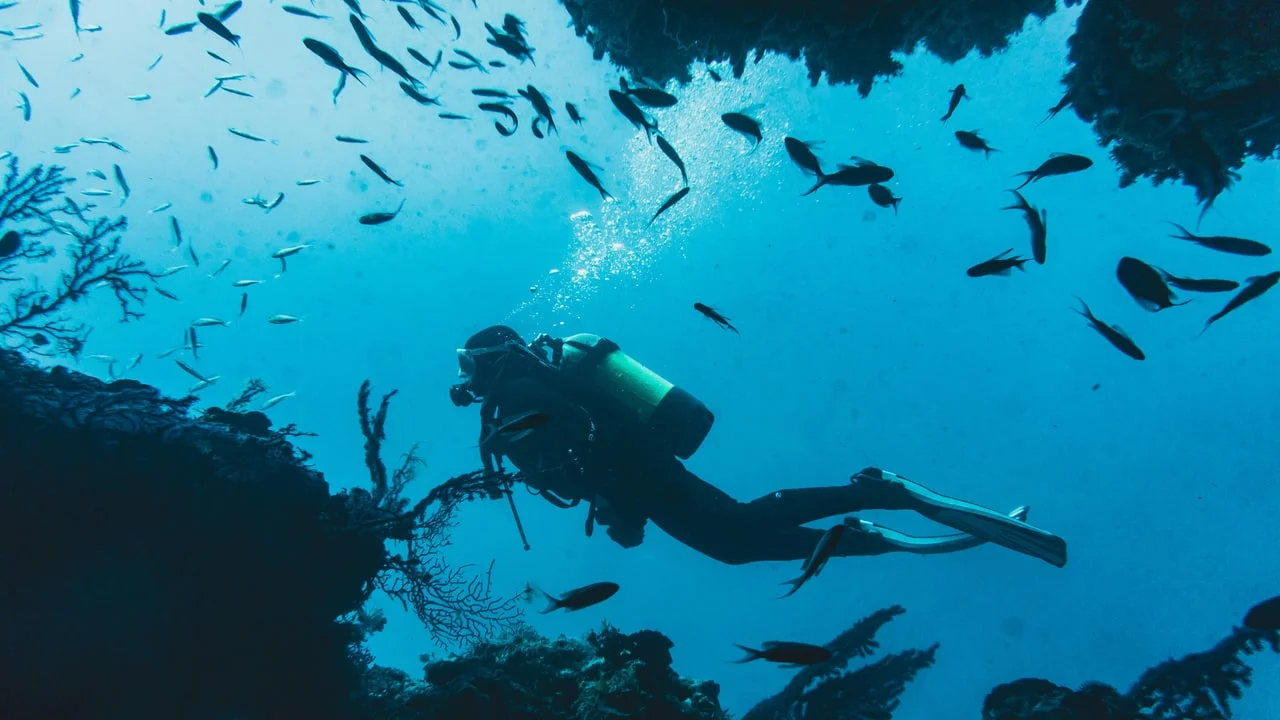
Subnautica — The Survival Game Where the Ocean Keeps Getting Darker and You Can't Stop Swimming Deeper
Today's pick: Subnautica (Unknown Worlds Entertainment, 2018). Metacritic 87 (PC) / 81 (Xbox) / 80 (PS4), IGN 9.1, GameSpot 9, OpenCritic 84 (top 9% of all games), Golden Joystick PC Game of the Year 2018, 5.23 million copies sold by January 2020. This guide covers how the depth-gated biome progression, fabricator crafting, and vehicle tier system work (no guns — evasion only), what players love and where the game genuinely frustrates them (no waypoints, awkward base-building, late-game grind, Unity pop-in), and a spoiler-free setup for Ryley Robinson and the alien ocean world of planet 4546B.

| Developer | Unknown Worlds Entertainment |
| Released | January 23, 2018 (PC/Mac) |
| Platforms | PC, PS4/5, Xbox One/Series, Nintendo Switch, iOS/Android |
| Genre | Underwater survival / open-world exploration |
| Metacritic | 87 (PC) · 81 (Xbox One) · 80 (PS4) |
| OpenCritic | 84 average · ranked top 9% of all games |
| Key reviews | IGN 9.1 · GameSpot 9 · Destructoid 9.5 |
| Sales | Over 5.23 million copies by January 2020 |
| Awards | Golden Joystick PC Game of the Year 2018 · Gamers' Choice Fan Favorite Indie Game 2018 |
Most survival games hand you an axe and a forest. Subnautica drops you into an alien ocean with nothing but a life pod and the sound of your own breathing. The crafting loop is familiar — gather materials, build tools, build bigger tools — but the world doing the pressuring is completely unlike anything else in the genre. Depth becomes the progression axis. The further down you go, the stranger it gets, the less oxygen you have, and the more clearly you understand that you are not the top of this food chain.1
Loading content card…
How it plays
You are Ryley Robinson, the lone survivor of a starship crash on planet 4546B — an ocean world with two small islands and an enormous, apparently bottomless sea. The game never gives you a quest marker or a waypoint. Instead, the lifepod's fabricator (a wall-mounted device that converts raw materials into almost anything) introduces you to the basic loop: scan creatures and fragments, collect resources, craft gear, dive deeper.2
Four difficulty modes let you choose how punishing you want it. Survival mode depletes health, hunger, thirst, and oxygen; Freedom mode removes hunger and thirst; Hardcore mode adds permadeath; Creative mode removes all resource requirements entirely.1 There's no wrong starting point — but Survival is where the intended tension lives.
The world is divided into biomes, each with distinct visual character and creature sets. The Safe Shallows near your pod are pastel and gentle. The Kelp Forest and Grassy Plateaus introduce the first creatures that will actually chase you. Go deeper and you reach the Jellyshroom Caves, the Blood Kelp Zone, the Grand Reef — each progressively weirder and better-resourced, each requiring better equipment to survive in. Descent is the game's core rhythm: upgrade your oxygen tank, push deeper, find the blueprint for the next upgrade, go deeper still.2
The vehicle progression follows the same logic. Early on you get the Seaglide, a handheld propulsion device. Then the Seamoth, a small one-person submarine. Then the Cyclops, a full-sized submarine that can itself carry smaller vehicles. Each vessel unlocks depth tiers and changes how the game feels — the Cyclops in particular shifts Subnautica from a diving game to something closer to a slow procedural exploration of what genuinely feels like an alien ocean floor.3
One deliberate design choice worth flagging upfront: there are no guns. Combat in Subnautica means evasion — using speed, noise-making decoys, or repulsion tools to avoid larger predators. The Reaper Leviathan and Ghost Leviathan are not bosses to be killed; they're environmental hazards to be navigated around. The development team made this choice deliberately, inspired partly by wanting a non-violent alternative to typical survival mechanics.1
What players are saying
The critical consensus in 2018 was almost uniformly enthusiastic. IGN called it "a survival game with focus and an excellent sci-fi story" and gave it 9.1.5 GameSpot scored it a 9 ("Superb"), praising "incredible atmosphere full of terrifying moments" and "scenic, evocative visuals showcasing a wide range of marine vistas," with only minor complaints about long load times and a few technical bugs.2 Eurogamer's verdict: "terror, wonder, and a generous whack of underwater DIY."3 OpenCritic puts the aggregate at 84, placing it in the top 9% of all reviewed games.6 It won PC Game of the Year and the Breakthrough Award for Unknown Worlds at the 2018 Golden Joystick Awards.1
The Metacritic user score (8.5 across 2,422 ratings) roughly mirrors the critical reaction, but the user reviews surface a few real splits worth knowing about:7
What fans are consistently enthusiastic about:
- The atmosphere. GameSpot's reviewer spent 40 hours in the game and described it as "so magical and otherworldly that it practically pains you to stop playing, even when you're filled with dread." That combination — wonder and unease simultaneously — comes up constantly.
- The progression pacing. Each new biome arrives at roughly the right moment: just as your current area starts to feel safe, you have the gear to push somewhere new and threatening.
- The sound design. The audio in Subnautica does real work — the ambient hum of deep water, the distant growl of something large, the silence that follows when you turn off your submarine's engines.
Where the game genuinely frustrates people:
- No map, no waypoints — on purpose. Director Charlie Cleveland wanted players to internalize the world through exploration, not follow markers.1 For some, that's the point; for others, getting turned around in the Mushroom Forest at hour 15 while your oxygen drains is enough to quit. One Metacritic user reviewer was direct: "I simply cannot afford to spend hours backtracking across a vast map just because I missed one-third of a blueprint five hours ago."7
- The base-building is rough. Eurogamer's review flagged this explicitly — the first-person building interface is awkward, structures often won't snap together properly, and indoor item placement has strict restrictions that force multiple return trips.3
- Unity engine pop-in. Fast movement across biome boundaries causes visible object loading. It's not game-breaking, but it breaks immersion at the exact moments when you're trying to appreciate a new environment.3
- The late game drags for some players. Once the exploration plateau arrives and most biomes are mapped, the resource grind to complete the final construction push feels longer than it needs to be. Several user reviewers note they enjoyed 30–40 hours thoroughly and then lost momentum before the ending.7
The game is genuinely not for everyone — players who need clear direction, combat satisfaction, or a traditional mission structure will find it frustrating. The positive-to-negative ratio on Metacritic (85% positive, 5% negative) suggests those players are a real minority, but they're not wrong about what the game is.
The story setup (no spoilers)
You are Ryley Robinson, a systems maintenance officer aboard the Aurora, a massive Alterra Corporation spacecraft on a routine construction mission. The Aurora crashes for reasons that become clear later. You eject in a life pod. You're alive. You appear to be the only person who made it.
The planet below — designated 4546B — is a water world. No continents, just ocean, two islands, and whatever is at the bottom. Your life pod's radio starts picking up distress signals from other pods. The Aurora's wreckage is visible on the horizon and will eventually become explorable. A rescue ship detects your signal and starts heading toward you.
That's the situation at hour one. What the planet actually is, why the Alterra Corporation was here in the first place, and what the structures on the sea floor are — all of that you find through exploration and environmental storytelling rather than cutscenes. The game delivers its lore through audio logs, data entries, and ruins, which means the revelations arrive at the pace you push for them.
The tone sits between Alien and Contact — lonely and occasionally frightening, but with a strain of genuine wonder underneath the dread. The writing, by Tom Jubert, earns that balance mostly without going sentimental.1
Should you play it?
Yes, if: You want a survival game where exploration feels like actual discovery — where turning a corner at 300 meters and seeing something you've never seen before is a regular occurrence. Subnautica's world is genuinely distinct from every other game in the genre, and the combination of beauty and low-level persistent anxiety it maintains for 30–50 hours is something almost no other game manages.
Think twice if: You need waypoints, a crafting recipe book that explains itself, or combat that lets you fight back. The intentional lack of direction is either the best thing about the game or a dealbreaker depending on your patience.
One practical note: The game has four difficulty modes and you can switch between them mid-playthrough. If you hit a frustration wall in Survival, dropping to Freedom (which removes food/water) is a legitimate way to stay in the exploration without fighting the survival systems simultaneously.
The sequel, Subnautica 2, launched in early access in May 2026 and pulled nearly half a million concurrent players within hours — if you want to know what all of that is about, the original is still the best place to start.9
Add more perspectives or context around this Post.