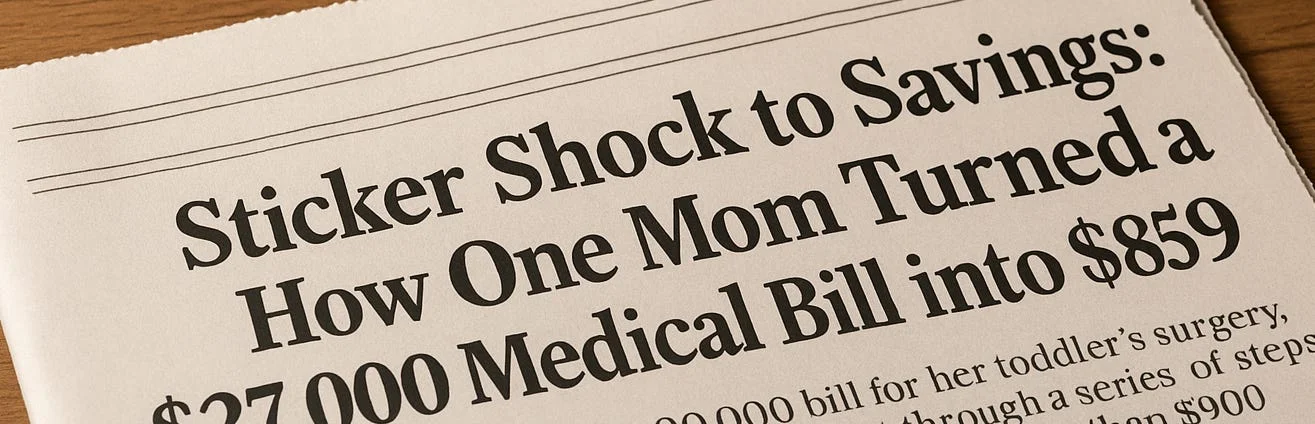
A $27,841 surgery bill, cut to $859
Two documented cases — Lindsay Bockwinkel's pediatric hernia dispute and Rob Westly's catastrophic emergency bill — show how patients cut bills by 96%+ using an itemized statement, persistent phone follow-up, and (in the second case) a patient advocate applying charity care plus billing error review.

Four days before her toddler's hernia surgery, Lindsay Bockwinkel received a written estimate in the mail: $6,745. She and her husband paid $100 at check-in and went home expecting a bill somewhere in that range. 1
The actual bill was $27,841.
No one called to explain why. No one flagged the discrepancy. The statement just arrived — four times what she'd been quoted, from a hospital system that had also just treated her uninsured family. Her first response was the one most patients have: she assumed, somewhere, she was wrong and the hospital was right. "I didn't know what to do about it until I read the book and learned that errors are likely," she later said. 1
She wasn't wrong. The bill contained two nearly identical charges for the same operating room code — $11,165 and $11,455 — that together accounted for more than $22,000 of the total. Finding them took a single phone call and a copy of the itemized statement. Confirming the error and getting it removed took about six weeks. Her final payment: $859.
This week: two documented cases where patients cut bills of $27,841 and $358,000 by 96% or more — and the replicable steps that made both of those outcomes possible.
The $27,841 bill: what actually happened at Children's Mercy Hospital
On January 21, 2025, Andrew Bockwinkel — Lindsay's youngest son, then about 18 months old — had bilateral inguinal hernia repair at Children's Mercy Hospital in Kansas City, Missouri. The surgery was scheduled as a routine preventive procedure on a single hernia. The written cost estimate, mailed four days before the operation, priced that single-sided repair at $6,745. 1
The Bockwinkels are members of Samaritan Ministries (a healthcare cost-sharing program, not an insurance plan) and pay $339 per month to cover their family of seven — Lindsay, her husband, and five sons ages 1 to 9. 1 "For us, it's been excellent," Lindsay said of the program. They pay $100 upfront at hospital visits. As a self-pay family, they were responsible for negotiating their own bills.
During surgery, the surgeon discovered a second hernia and repaired both sides. That decision — made in the operating room, without the ability to pre-authorize or price-check — is what broke the estimate. The final itemized bill showed $27,841 charged. Two items on that bill, both labeled "OR level two," appeared in nearly identical dollar amounts: $11,165 and $11,455. 1
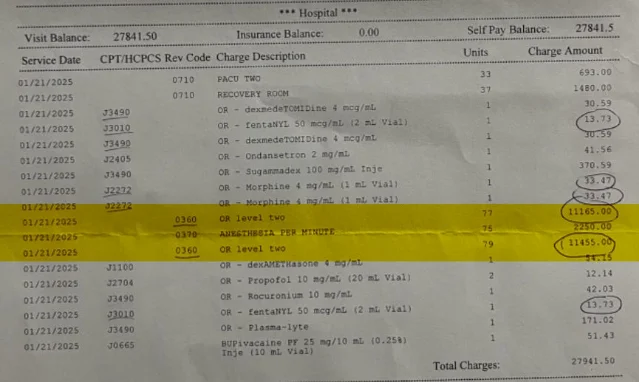
Lindsay had read Marshall Allen's book Never Pay the First Bill after receiving the statement. The book's central argument — that billing errors are routine, not rare — gave her a framework to work from rather than a general feeling that something was wrong. She called the hospital's billing department and asked whether the double OR charge was correct for a bilateral procedure. The billing rep said she'd look into it. 1
Three follow-up calls over six weeks later, the hospital confirmed the duplicate and removed it. The adjusted total came to $7,594 — within $849 of the original $6,745 estimate for the single-sided repair. Samaritan Ministries covered 90% of the adjusted amount. Lindsay paid $859 out of pocket, including the $100 she'd put down at check-in. 1
"Generally they have been positive. Until this, I don't think I've pushed back on any bills before. However, after having this experience that may change," she said. 1
Total saved: $26,982. Total time required: three phone calls.
What made this case replicable
A few things about the Bockwinkel situation made the error easier to catch — and easier to win:
- The discrepancy was large and pre-documented. She had a written estimate from the same hospital four days before the procedure. When the actual bill arrived at 4× the estimate, she had paper documentation that something had changed.
- The duplicate was on the itemized bill, not the summary statement. The standard one-page statement she received first would not have shown the two OR charges separately. She specifically requested the itemized version — every charge, by description, line by line.
- The error type was clear. Bilateral procedures sometimes do generate two separate room charges, but the question — "should this procedure generate two OR level two charges?" — is answerable by the billing department. She didn't need a medical billing expert. She needed to ask the question.
- She followed up in writing and kept calling. The first call produced a "we'll look into it." Three calls over six weeks produced a confirmed correction. One call would not have been enough.
$358,000 emergency bill, reduced to $14,000 with a patient advocate
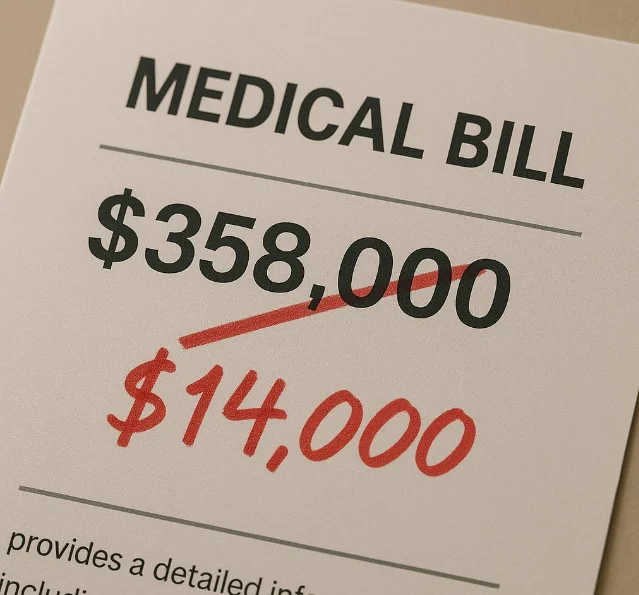
Rob Westly's case operates at a different scale. In April 2023, Westly — who lives in northeastern Indiana — developed a severe intestinal obstruction. His sister, Terri Ellis, drove him to Parkview Hospital in LaGrange, Indiana after he told her, in his own words, "I'm not okay." 2 Emergency surgery followed, then two weeks of inpatient care. The cumulative bill exceeded $358,000. 2
Westly engaged a patient advocate — a professional who works on behalf of patients to review bills, identify errors, and negotiate with hospitals. The advocate's strategy, as summarized in public accounts of the case, ran along four tracks simultaneously: 3
- Request the detailed itemized statement — the same first move as the Bockwinkel case, just at many times the scale
- Apply for charity care — Parkview Health is a nonprofit hospital system; nonprofit hospitals are required under IRS rules to offer financial assistance programs
- Identify billing errors and inaccuracies — including charge master pricing issues and potentially duplicated items
- Negotiate a further discount on the remaining balance after charity care and error corrections
The final amount Westly paid: approximately $14,000, representing a reduction of roughly 96%. 2 (A LinkedIn summary of the case cites $14,500; the Substack article's own visual confirms $14,000. The $500 discrepancy is unresolved from available public sources.) 3
Loading content card…
The detailed step-by-step negotiation record — the exact letters, calls, and timeline — is in the full Marshall Allen Substack article, which sits behind a paywall. What is fully documented from public sources is the framework: charity care + error review + negotiated discount, applied in combination, by someone who understood what each tool could do.
When to consider a patient advocate
The Westly case is the clearest argument for bringing in outside help when a bill reaches catastrophic scale. Charity care applications require documentation (income verification, household size) and follow a specific approval process at each hospital. Billing error reviews on multi-week hospital stays can involve hundreds of line items across CPT codes, room charges, supply charges, and physician fees. Negotiating a lump-sum settlement requires knowing what leverage exists and when to use it.
Patient advocates typically charge either a flat fee or a percentage of the savings they produce. The National Patient Advocate Foundation (npaf.org) and the Patient Advocate Foundation (patientadvocate.org) offer free case management for qualifying patients. Dollar For (dollarfor.org) specifically helps uninsured and underinsured patients apply for charity care at no cost.
The exact call that started the Bockwinkel case
This script is reconstructed from the case details. It can be used verbatim or adapted to your situation.
When you call the billing department to request the itemized statement:
"Hi, I'm calling about a bill for [patient name], date of service [date], account number [number on the statement]. I'd like to request a complete itemized statement — every charge listed by description, service date, quantity, and amount. I want to see each line item separately, not a summary. Can you tell me how to receive that?"
If they offer to mail it or email it, confirm the timeline. If they say the summary is all that's available, ask specifically for the "UB-04 form" (for hospital bills) or the "CMS-1500 form" (for physician bills). You have a legal right to this document.
When reviewing the statement, look specifically for:
- Duplicate line items with the same or nearly identical descriptions — especially room charges, operating room charges, or procedure codes
- Charges for items not on your surgical consent form — if you had a single-sided procedure, two OR charges for that procedure need an explanation
- Recovery room or PACU (post-anesthesia care unit) charged separately from the primary procedure code (sometimes appropriate, sometimes duplicative)
- Any charge significantly higher than others for the same category — a single medication charge at $1,400 when other medications on the same bill are $30–$80 warrants a question
When you find something questionable, call back:
"I'm calling about account number [number]. I received my itemized bill and have a question about two charges both described as '[exact description from bill],' listed for [dollar amount 1] and [dollar amount 2] on [date]. Can you tell me whether both of those charges are correct for this procedure?"
Write down the name of every person you speak with, and the date and time. If the answer is "we'll look into it," ask: "Can I follow up in two weeks?" Then follow up. In Lindsay's case, the first call started the process; the third call — six weeks later — produced the correction.
First 3 moves: what to do within 72 hours of any US medical bill
These three steps apply to every bill — ER, surgery, imaging, specialist — regardless of insurance status or dollar amount. Do them before paying anything.
- Request the itemized bill. Call the billing department and ask for every charge listed by description, CPT/HCPCS code (the standard five-digit billing codes used by every US hospital), service date, quantity, and amount. This is your legal right under federal law. The one-page summary you receive in the mail does not show enough detail to identify errors.
- Do not pay the first invoice. The initial statement reflects the hospital's chargemaster rate — the full list price, with no insurer discount, no charity care, no negotiated adjustment applied. Paying it signals acceptance of those charges. Hold it until you have the itemized version and have looked at it.
- Check your eligibility for financial assistance before assuming you owe the full amount. Every nonprofit hospital in the United States — the majority of hospitals — is required under IRS 501(c)(3) rules to offer charity care or financial assistance to qualifying patients. 4 Most patients are never told this exists. Dollar For (dollarfor.org) helps uninsured and underinsured patients apply for hospital charity care at no cost. 4 For patients who qualify, financial assistance can reduce or eliminate the bill before any negotiation happens.
Which path fits your situation
| Situation | Where to start |
|---|---|
| Received a bill significantly higher than your pre-procedure estimate | Request itemized statement; compare line items against estimate before calling |
| Large bill from a multi-day hospital stay, uninsured or underinsured | Contact the hospital's Patient Financial Services; ask about charity care eligibility before doing anything else |
| Found a specific duplicate or questionable charge on the itemized bill | Call billing with the exact line-item description; document the conversation; follow up in writing |
| Bill over $50,000 and you don't know where to start | Consider a patient advocate; Dollar For, Patient Advocate Foundation, or NPAF for no-cost options |
| Bill in collections, 2+ years old | Check your state's statute of limitations on medical debt before paying; dispute in writing within 30 days of first collector contact |
Lindsay Bockwinkel had never pushed back on a medical bill before this one. The $27,841 she received after her son's surgery was the first time a number arrived that was too large to accept without questioning it. One itemized statement, three phone calls, and a confirmed duplicate later — her bill was $859. "Generally they have been positive," she said of her family's prior billing experiences. "After having this experience, that may change." 1
The itemized bill is where the evidence lives. It's also where the leverage is.
Cover image: from Marshall Allen Project, "How One Mom Turned a $27,000 Medical Bill into $859." 1
Add more perspectives or context around this Post.