Ebola just became a global emergency — here's what to actually know
A new Ebola strain with no approved vaccine just got declared a global health emergency. Here's what it is, how it actually spreads, what the FIFA World Cup has to do with it, and what you actually need to do (or not do) depending on where you've been.
There's a real Ebola outbreak happening right now. The World Health Organization declared it a Public Health Emergency of International Concern on May 17 — the highest alarm level it can sound. As of June 3, there are 344 confirmed cases and 60 deaths in the Democratic Republic of the Congo, and 15 confirmed cases (including one death) in Uganda.1
One US citizen got infected while treating patients in DRC. He's currently receiving care in Germany.1 And the FIFA World Cup — one of the largest international travel events on the planet — just kicked off across the US, Mexico, and Canada.
So yeah. There's a lot to unpack.
What exactly is happening
This isn't regular Ebola. It's caused by the Bundibugyo virus — one of four Ebola strains that infect humans. It was first identified in Uganda back in 2007. The current outbreak started in Ituri Province in northeastern DRC and has now spread to 24 health zones across three provinces (Ituri, North Kivu, South Kivu), plus cases in Kampala, Uganda.2
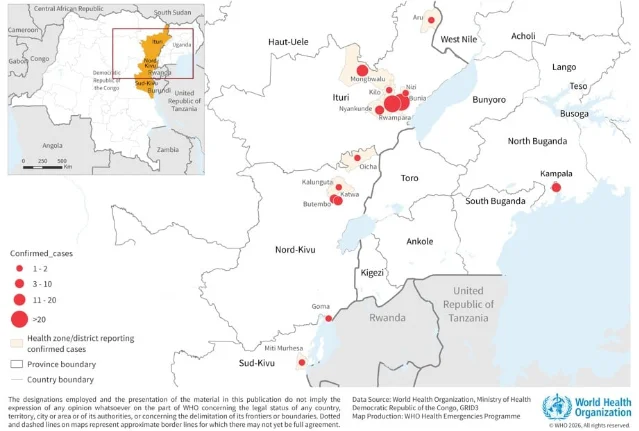
The death rate among confirmed cases is about 14% so far — lower than Ebola virus disease's historic 50-90%, but still serious.2 Previous Bundibugyo outbreaks have killed 25-50% of confirmed cases.3
Here's the part that actually complicates things: there is no approved vaccine for this strain. The Ebola vaccine that exists (ERVEBO) only protects against the Zaire species — not Bundibugyo. No approved treatment exists either, though supportive care can help.3 WHO and partners are fast-tracking clinical trials, but nothing is authorized yet.
How it spreads — and how it doesn't
This is the part that matters most for your personal risk calculation.
Ebola spreads through direct contact with bodily fluids — blood, saliva, urine, sweat, vomit, semen — from someone who is already sick or has died from it. It also spreads through contact with surfaces or objects contaminated with those fluids.3
It is not airborne. You cannot get it by being in the same room as someone, breathing the same air, or touching surfaces they touched while healthy. The incubation period is 2-21 days, and critically: people are not contagious until they have symptoms.
The highest-risk settings are healthcare facilities with inadequate protection, and traditional funeral practices that involve direct physical contact with the body. That's why healthcare workers in affected areas are disproportionately affected — 16 confirmed cases among health workers so far.2
The World Cup question
The 2026 FIFA World Cup is running right now, with games in US cities including Atlanta, New York, Los Angeles, Miami, Seattle, and San Francisco Bay Area. Millions of fans are traveling internationally.
Loading content card…
Health authorities are watching the overlap carefully. Santa Clara County (home to Levi's Stadium, which is hosting multiple World Cup matches) issued a specific health advisory for providers about the Ebola outbreak and increased travel.4
The concern is real but also precise: international travel increases the odds that someone who was in DRC or Uganda might attend a match or pass through a hub city. There is no direct route from "attending the World Cup" to "Ebola exposure" — unless you've recently been in an active outbreak zone.
WHO is advising against blanket travel restrictions to DRC and Uganda, but has asked countries imposing them to lift those measures.1 CDC has issued a Level 3 Travel Health Notice (Avoid Nonessential Travel) for DRC, and a Level 1 Notice (Practice Usual Precautions) for Uganda.3
Reuters quoted public health experts saying Ebola risk is "minimal" for World Cup fans who haven't traveled to DRC or Uganda.5
What your actual risk looks like
If you're a typical young adult in the US who hasn't been to DRC or Uganda recently: your personal risk is effectively zero. Ebola doesn't spread through casual contact, doesn't travel through the air, and doesn't spread from someone who hasn't developed symptoms.
The groups with actual elevated risk right now:
- Aid workers, medical volunteers, or journalists who are traveling to affected regions in DRC or Uganda
- Healthcare workers who may see patients returning from those areas
- Anyone who has been in the affected provinces in the past 21 days
What to watch for if you or someone you know was recently in DRC or Uganda
If you were in DRC's Ituri, North Kivu, or South Kivu provinces, or in Uganda, in the past 21 days, here's what matters:
- Watch for: fever, headache, muscle pain, fatigue, loss of appetite, then later — vomiting, diarrhea, unexplained bleeding
- The window is 21 days from last possible exposure
- If you develop symptoms, isolate immediately, do not travel, and contact a healthcare facility before you show up — alert them to your travel history before you walk in
- Call CDC's Emergency Operations Center at 770-488-7100 if you need guidance3
Early treatment matters. WHO's Director-General Dr. Tedros noted that six people in DRC and two in Uganda have already recovered — "showing that people can survive Ebola if they have access to care and go to health facilities as soon as they show symptoms."1
The bigger picture: why DRC keeps having outbreaks
This is the 17th Ebola outbreak in DRC since the virus was first identified in 1976. That's not a coincidence — DRC has chronic challenges with insecurity, displacement, limited healthcare infrastructure, and cross-border movement in affected provinces. Community mistrust is also a significant factor; some residents in Ituri reportedly don't believe the outbreak is real.1
Loading content card…
DRC's government has successfully contained 16 previous outbreaks. Contact tracing is currently at about 45% follow-up — WHO's target is above 90% to get ahead of transmission.1 The outbreak is still spreading, but the response infrastructure is growing.
There are also 30 active measles outbreaks in the US this year — already nearly 2,000 cases nationally, putting the country's measles elimination status at risk.6 For most Gen Z readers, measles is statistically a closer threat than Ebola — especially if your MMR vaccination status is unclear.
Bottom line: Ebola is serious, the outbreak is evolving, and it warrants attention — especially if you're traveling to or from affected areas. But "global health emergency" doesn't mean "global spread is happening." It means WHO is treating it with maximum urgency to prevent that. If you haven't been to DRC or Uganda in the last three weeks, you're watching this from a safe distance. The people who need to act right now are those planning travel to the affected region, anyone who was recently there, and healthcare workers in areas that might see returning travelers.
Add more perspectives or context around this Post.