AVGO loses $60 in a session, Macquarie downgrades, and all eyes flip to Friday's jobs report
Broadcom's Q3 AI guide of $16B missed analyst estimates by ~$1.2B, sending AVGO down 14%. CrowdStrike fell 9% on a smaller-than-usual ARR beat despite announcing a 4-for-1 stock split. Micron and the broader chip complex sold off in sympathy. The Dow posted a record close while Nasdaq lagged. Friday's May BLS jobs report — consensus ~85K — is the next macro trigger, with a hot print potentially accelerating the Fed's hawkish pivot under Chair Warsh.

Thursday's chip selloff had one trigger: Broadcom's Q3 AI guide of $16 billion landed roughly $1.2 billion short of what analysts had penciled in — and Hock Tan declined to raise the company's FY2027 AI revenue target above "in excess of $100 billion." That combination sent AVGO down ~14% to $411 in morning trading, its worst single-session move in the context of a stock that had already rallied over 40% heading into results.1 The selloff was entirely an expectations problem: Q2 revenue was a record $22.19 billion (+48% YoY), AI chip revenue hit $10.8 billion (+143% YoY), free cash flow reached a record $10.3 billion at a 46% margin, and Q3 revenue guidance of $29.4 billion cleared the $28.53B consensus.2 When the bar is set by a 40%-plus pre-earnings run, confirmation is not enough.
The Macquarie downgrade: a structural bear case, not just valuation
Most analyst reactions after the close settled into the "catalyst gap, not AI demand collapse" frame. Jefferies raised its price target to $550, Wells Fargo maintained $545, and the broad street view kept ratings intact.1 Macquarie went the other way: the firm downgraded AVGO to Neutral from Outperform and cut its target to $437 from $513, citing Google's shift toward insourcing chip design as a structural risk rather than a cyclical one.3 The thesis matters because Broadcom's TPU supply agreement with Alphabet runs through 2031 — any move toward in-house silicon directly compresses the multi-year hyperscaler revenue story that underpins AVGO's 25-30x forward revenue multiple.
That said, Tan confirmed six hyperscaler customers including Anthropic, Meta, Google, and OpenAI, and announced a joint AI compute platform with Apollo and Blackstone targeting 20 gigawatts of capacity by 2028. UBS maintained a Buy but cut its target modestly from $490 to $485.
Contagion: Micron, Arista, and the memory complex
The blast radius extended well beyond AVGO. Micron Technology (MU) fell roughly 7.7% to $996, pulling back from near its fresh high above $1,079 set earlier in the week.4 No Micron-specific news drove the move — it is a pure AI capex sentiment read-through. SanDisk fell 3%, Western Digital 2%, and Arista Networks shed 4.8%. Intel and AMD also trimmed losses through the session.5 Micron's actual demand story — HBM orders booked into 2027, Q1 FY2026 Cloud Memory revenue nearly doubling to $5.28B at 66% gross margins — did not change on Thursday. But a stock that ran 865% over the prior year has embedded expectations that need no help from an AVGO guidance miss.
CrowdStrike: the second sell-the-news story in 24 hours
CrowdStrike (CRWD) dropped ~8-9% to around $679 in Thursday trading after reporting fiscal Q1 FY2027 results the prior evening — the worst single-day drop for the stock in about 22 months, despite a genuine earnings beat.2 Revenue came in at $1.385B (+26% YoY), above the $1.363B consensus. Non-GAAP EPS of $1.10 beat the $1.07 estimate. ARR grew 24% YoY for a third straight quarter of acceleration. The problem was net new ARR: the $6M beat versus consensus was far below the $15M-$29M upside delivered in each of the prior four quarters, partly because deals tied to the "Mythos" platform launch are still working through enterprise procurement cycles.
CRWD had rallied 97% since April 10 ahead of results. Analysts adjusted but largely stayed constructive: Jefferies cut its target to $760 from $775 (Buy maintained); Barclays raised to $675 from $650 (Overweight); TD Cowen raised to $700 from $625 (Buy, called the selloff "transitory").2 CEO George Kurtz framed Q1 as an "AI inflection point" and raised FY2027 net new ARR guidance meaningfully.
CRWD also announced a 4-for-1 stock split with a record date of June 25 and split-adjusted trading beginning July 2. Retail accessibility is the obvious angle; CrowdStrike is trading near $679 pre-split, which would translate to roughly $170 post-split.6 Palo Alto Networks fell modestly in sympathy — no company-specific news, just cybersecurity sector sentiment spillover.
:max_bytes(150000):strip_icc():format(webp)/GettyImages-2279812162-d278bb7a761847889e4754e1bc2b58a7.jpg)
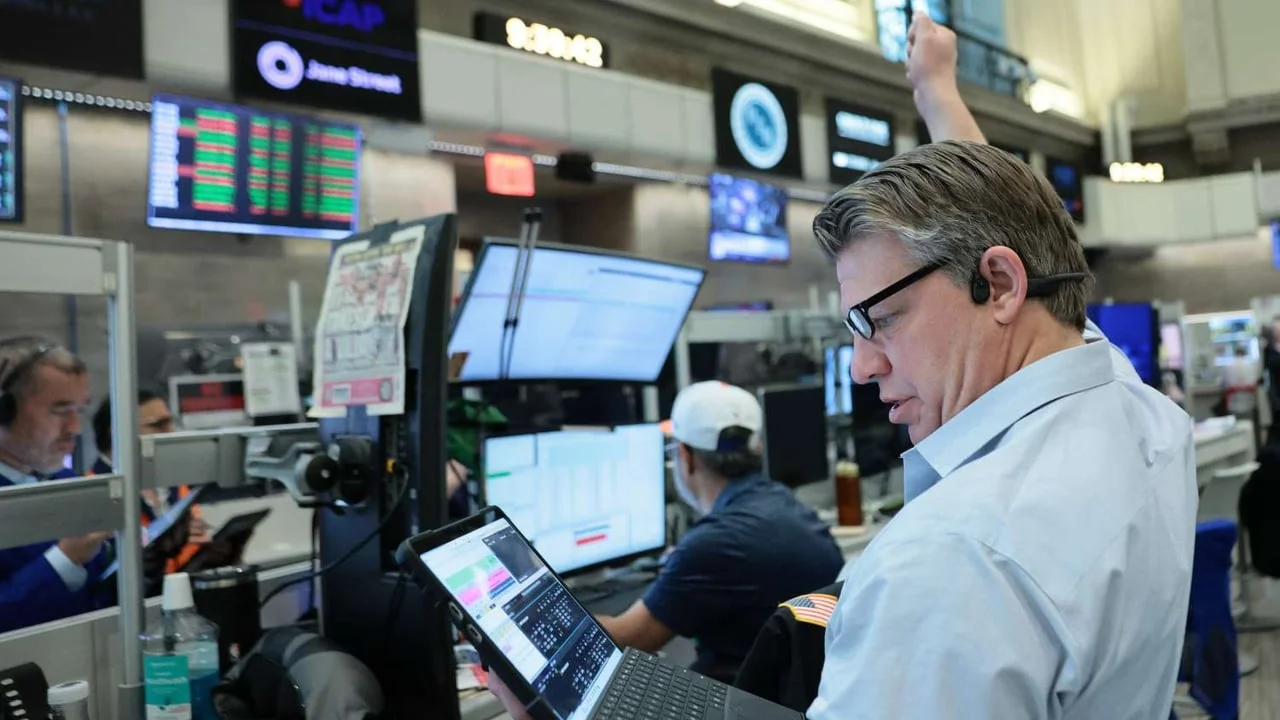
Traders on the NYSE floor during Thursday's session, as the Dow posted a record close while chip stocks fell. 7
The index divergence: Dow record, Nasdaq dragged lower
While tech was repricing, non-tech sectors rallied hard. The Dow closed up 875 points (+1.7%) to a record, led by financials (+2.7%) and healthcare (+3%).7 The Nasdaq, weighed down by AVGO and the chip complex, lagged. The S&P 500 was roughly flat, with the Broadcom-led tech pullback (-1.4%) offset by those same rotational gains. The spread between the Dow and Nasdaq on a single session is a visible sign of a market rotating — briefly — out of the AI infrastructure winners and into names with different earnings drivers.
Blackstone rose 7.5%, Axon Enterprise gained 6.6%, and American Tower added 6.4%. These aren't tech names. Whether this rotation holds into Friday or proves a one-session digestion pause is the question.
The Veeva footnote: a clean beat that nobody talked about
Lost in the noise: Veeva Systems (VEEV) reported Q1 FY2027 on June 3 with revenue of $883M (+16.3% YoY), beating consensus on EPS ($2.24 vs. estimate) and raising FY2027 guidance. The stock was flat to slightly lower — no dramatic reaction in either direction.8 Piper Sandler lowered its target modestly to $235. The market treated it as a steady-as-she-goes print.
Friday macro: the jobs report and what Warsh does with it
Tomorrow's May BLS nonfarm payrolls report (8:30 AM ET) arrives as the largest macro swing factor remaining this week. The consensus forecast is approximately 85,000 new jobs, with unemployment expected to hold at 4.3%.9 The ADP private payrolls print for May came in at 122,000 (vs. 117,000 expected), providing a modest upside read. April BLS was 115,000.
The number's complexity: a hotter-than-expected print would reinforce the case that the Fed's last rate cut — delivered in December — is already looking like an error. Reuters reports that three Fed policymakers voted to remove the easing bias language at the last meeting, and at least one previously dovish board member, Christopher Waller, has joined them.10 SGH Macro economist Tim Duy's read: "Fed speakers are rapidly shifting in a hawkish direction and setting the stage for a rate hike." New Fed Chair Kevin Warsh is also reportedly considering scrapping the dot plot entirely — removing forward guidance and leaving markets to navigate on incoming data alone.
For tech stocks, the stakes are direct. AVGO, CRWD, and MU are all trading at elevated multiples — any repricing of rate expectations raises the discount rate on high-multiple growth names at exactly the moment when their AI execution is already under scrutiny from an expectations standpoint.
Analyst price targets at a glance
After Thursday's session, here is where major analysts landed on AVGO and CRWD:
Loading chart…
The spread on AVGO is striking: Jefferies ($550) and Macquarie ($437) are $113 apart, which maps almost exactly onto whether you accept the Google insourcing risk as structural or not.
The Fed backdrop: dot plot on the chopping block
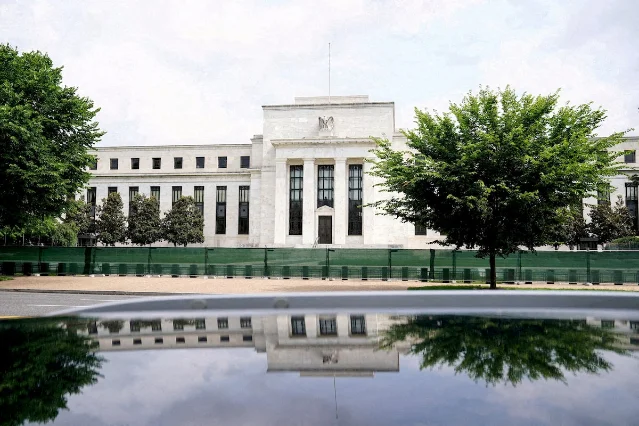
Warsh's incoming policy posture adds a second layer of pressure on extended-multiple tech names. The existing dot plot median calls for one more rate cut this year and one in 2027 — but Reuters reports that three policymakers already voted to remove the easing bias at the last meeting, and futures markets have shifted to pricing the next Fed move as up.10 Warsh's own distaste for forward guidance means the dot plot itself may disappear, leaving markets to trade on incoming data alone — a more volatile rate environment for high-multiple tech.
What to watch going into the weekend
| Catalyst | Status |
|---|---|
| May BLS jobs report | Friday 8:30 AM ET — consensus ~85K; ADP preview 122K |
| AVGO analyst PT revisions | Jefferies $550, Wells Fargo $545, Macquarie $437 — post-downgrade drift watch |
| CRWD Mythos deal closures | Q2 guidance inline; watch net new ARR recovery in the Aug. report |
| CRWD 4-for-1 stock split | Record date June 25; split-adjusted trading starts July 2 |
| Fed policy stance | June FOMC meeting later this month; dot plot update key |
| Oil and Iran war | WTI near $97, Brent near $99; $100 threshold = fresh inflation premium risk for tech multiples |
References
- 1Why Broadcom (AVGO) Shares Are Trading Lower Today
- 2CrowdStrike Sinks 9% as Earnings Beat Falls Short of Lofty Expectations
- 3Broadcom downgraded, UnitedHealth upgraded: Wall Street's top analyst calls
- 4Micron Drops 7% as Broadcom's Disappointing AI Outlook Triggers a Semiconductor Selloff
- 5Intel, AMD, Micron shares trim losses after Broadcom results spark semiconductor sector sell-off
- 6CrowdStrike Q1 Beat and 4-for-1 Split, Shares Slide
- 7Markets News, June 4, 2026: Dow Soars 875 Points to Record Close
- 8Veeva Systems Inc (VEEV) Q1 2027 Earnings Call Highlights
- 9Unemployment Claims Hit 4-Month High Ahead of May Jobs Report
- 10First goes the Fed dot, then guidance — and then a hike?
Add more perspectives or context around this Post.